Longshot joins USAF's AEDC Velocity Alliance consortium
Key Highlights
- The company's accelerator allows for repeated firings, enabling extensive data collection and iterative testing processes.
- Initial hydrogen testing is scheduled for fall 2026, targeting speeds above Mach 5 with payloads up to 2 kilograms.
- A larger launcher capable of accelerating payloads to Mach 5-7 is planned for early 2027, supporting advanced defense technology development.
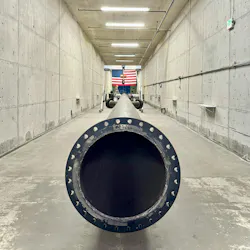
ALAMEDA, Calif. - Longshot, a kinetic space launch company developing a ground-based accelerator designed to achieve hypersonic velocities, has been selected for the AEDC Velocity Alliance, a new Air Force consortium focused on modernizing the nation’s test infrastructure, including capabilities supporting hypersonic technologies.
The Velocity Alliance was established by the Arnold Engineering Development Complex (AEDC), in partnership with the Air Force Test Center, to create a pre-qualified industrial base for engineering and construction projects focused on sustaining, restoring, and modernizing critical test infrastructure for advanced defense technologies.
Longshot says it is the only Velocity Alliance member developing kinetic test accelerators intended to support full-scale systems testing in low-level free flight. The company’s ground-based, multi-injection accelerator is designed to propel payloads to hypersonic speeds at a lower cost than traditional rocket-based testing approaches, according to the company.
Related: NASA Langley eyes public-private leases to accelerate hypersonics and autonomy hub
Unlike single-use missile systems that offer limited opportunities to collect test data, Longshot’s accelerator is designed for repeated firings, enabling test teams to conduct multiple iterations and gather additional performance data.
Alameda HQ
Longshot recently secured a $5 million investment, bringing the company’s total funding to $20 million. The investment followed the company’s acquisition of a former U.S. Navy hangar at Alameda Point, Calif., as its new headquarters.
The Alameda facility will support Longshot’s design, assembly, and testing activities for ground-based launch hardware. The company plans to begin initial hydrogen testing in fall 2026, targeting speeds above Mach 5 with payloads up to 2 kilograms. A larger launcher capable of accelerating payloads weighing hundreds of kilograms to Mach 5-7 is planned for early 2027, according to Longshot.
"We’re grateful for the support the Air Force is providing industry partners as we work to modernize testing at speed," said Mark Bigham, Longshot vice president of defense. "Longshot gives the Velocity Alliance something unique: a way to generate hypersonic test conditions for full-scale systems on demand, at significantly lower cost and lead time than other approaches."
AEDC has allocated federal funding for future modernization efforts involving test facilities and ranges across the country. Longshot’s membership positions the company to compete for infrastructure projects as AEDC advances its modernization portfolio.
What is the AEDC Velocity Alliance?
The government established the Velocity Alliance to support sustainment, restoration, and modernization of test infrastructure needed to validate advanced defense technologies operating at higher speeds and altitudes. The effort also requires integration with sensors and data networks.
The alliance covers project areas including construction, process systems, electrical engineering, fire suppression, and equipment repair.
Potential performance locations include Arnold Air Force Base in Tennessee, Holloman Air Force Base in N.M., Tunnel 9 in Md., and the National Full-Scale Aerodynamics Complex in Calif.
