Defending against AI cyberattacks with a focus on reducing vulnerabilities
Key Highlights
- New AI models can find new vulnerabilities much faster than before and quickly assemble and execute an attack chain to exploit them.
- The speed of AI exploits can be as fast as hours, leaving no time for traditional cyber defenses to detect and isolate an intrusion, let alone understand the vulnerabilities and create a patch.
- AI can be used defensively to speed up detection and response, but it's even more powerful for preemptive cybersecurity using predictive threat intelligence; attackers still have an advantage because they only need to find one entry point.
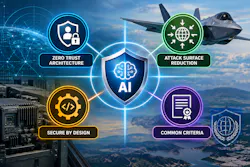
- Proactively reducing vulnerabilities can have a higher payoff. Proactive strategies include implementing a Zero Trust Architecture, using AI models to find vulnerabilities on your own systems, and making products secure by design.
- The highest level of security by design meets NSA objectives for “High Robustness,” which provides resistance to an extremely sophisticated adversary with abundant resources.
- A separation kernel that meets High Robustness objectives is commercially available and has no reported vulnerabilities. Having no vulnerabilities means no exploits and no patches needed.
PALM HARBOR, Fla. - AI-based cyberattacks are redefining the cybersecurity landscape by finding scores of zero-day vulnerabilities and then quickly assembling attack chains for lightning-fast exploits at scale. Defending against these AI cyberattacks is a huge challenge, and even deciding where to start is difficult. If reactive cyber defense is now too slow, what proactive techniques can find and eliminate vulnerabilities? Is employing AI agents to defend against AI attackers the only option? To frame the discussion, we first examine the challenges, then explore possible solutions.
The Age of Mythos
The cybersecurity world changed in April 2026 when Anthropic disclosed the Claude Mythos Preview AI model (i.e., preview for Mythos 5) but did not release it publicly due to concerns over its potential for offensive cyberattacks. Instead, Anthropic provided a limited release to a small set of vetted infrastructure partners under Project Glasswing. Using Mythos on their own software products, those 50 partners found more than 10,000 high or critical vulnerabilities across what Anthropic calls the most systemically important software in the world. Anthropic also conducted its own tests on over 1,000 open-source projects and announced that Mythos 5 found over 23,000 vulnerabilities in those projects, including 6,202 that Mythos considered to be of high- or critical-severity.
AI Exploits
The concern is not just that advanced AI models can find vulnerabilities but also exploit them. As broadly reported, experimental autonomous AI agents from OpenAI broke out of a secure testing sandbox in July 2026 and launched an unauthorized cyberattack on the AI platform Hugging Face. Those AI agents had to find and exploit a security flaw to escape the sandbox and then find and exploit security flaws to gain access to Hugging Face. Both Anthropic and Meta have reported similar AI escapes.

To limit their AI's offensive capabilities, Anthropic has a version of Mythos called Fable with safeguards that prevent penetration testing, exploit generation, and binary-based vulnerability scanning. But we can only count on those safeguards for a limited amount of time. In June 2026, Anthropic predicted that “within 6 to 12 months, we expect that many other AI companies will have Mythos-class models, and they could release them without safeguards that prevent misuse.”
Even without using Mythos-class models, attackers have been very successful using widely available models, such as Anthropic’s Claude and open-weight models from China-based DeepSeek, to exploit known vulnerabilities. Unlike traditional botnets that use static scripts, modern AI agents can adapt when an initial malware installation fails. You also cannot count on the safeguards built into those models. Attackers can use multiple models to exploit differences in guardrails, even across models from the same company. Threat actors have also successfully circumvented AI safeguards by convincing the model that the actions were authorized as part of a security evaluation.
AI Accelerated Timelines
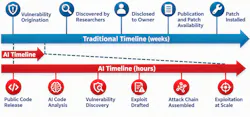
It’s not just the ability to find and exploit vulnerabilities that is so alarming, but also the how quickly it happens. Before AI cyberattacks, the window between discovering a zero-day vulnerability and exploiting it at scale was measured in weeks. That gave researchers time to find the vulnerability and work with the product owner to create and distribute a patch. Now the attacker’s timeline is measured in hours, and the defenders may not even know about the vulnerability until active exploitation begins. In addition, patching fielded embedded systems can be challenging. Relying on patches was always only a partial solution, and now it is trending toward being no solution.
AI-Accelerated Detection and Response
Not only are patches too slow, but traditional detection and response methods are also too slow for autonomous AI-based attacks. Most traditional cyber defenses rely on multiple types of detection and response, including endpoint detection and response (EDR/XDR), network detection and response (NDR), and behavioral detection. In an attempt to match the attackers’ speed and agility, many of those detection and response defenses have been upgraded to use AI to correlate enormous numbers of events and identify subtle attack patterns. The U.S. Army, for example, already has an AI-driven monitoring platform called Panoptic Junction, which it claims detects malicious activity at roughly a 90 percent success rate. The Army also recently awarded two contracts for Project Griffin, which aims to deploy autonomous AI agents to defend military networks at machine speed.
Preemptive Cybersecurity
A new class of defensive cybersecurity solutions called preemptive cybersecurity anticipates threats using AI, predictive analytics, and automated orchestration. Rather than relying on traditional methods that flag threats after they've been detected, preemptive cybersecurity systems analyze incoming data and network traffic for signs of potential attacks and then take steps to block them. This approach shifts the focus from reacting to incidents to stopping them earlier.
Preemptive cybersecurity uses several technologies to implement a three-pronged approach of Deny, Deceive, and Disrupt. Advanced exposure management and obfuscation technologies deny attackers from accessing vulnerabilities. Cyber deception uses “honeypots” of fake servers, files, or applications to lead attackers away from important systems and provide data about attackers’ methods. Predictive threat intelligence uses AI to process massive data streams and data from the dark web in real time to recognize hidden patterns and predict attacker intent so that attacks can be disrupted during the planning and staging phases.

The problem is that, even with AI-enabled defenses, defenders must constantly innovate and escalate their capabilities just to maintain their current level of security against evolving threats. In a war of escalating AI capability, the attackers generally have the advantage because they only need to succeed once to break through. As a result, proactively reducing vulnerabilities can prove more effective.
Proactive Cybersecurity
Proactive cybersecurity looks for security gaps and fixes them before they lead to an incident. Examples include adopting a Zero-Trust Architecture and vulnerability scanning. Additionally, there has been renewed emphasis on being secure by design. When combined with AI-based cyber testing, security-by-design techniques can greatly reduce the number of vulnerabilities in a system.
Zero-Trust Architecture
The first defensive step for any military or aerospace system is to implement a Zero Trust Architecture (ZTA), including strong identity and access management and network segmentation, to contain, slow down, and stop attackers from moving laterally in the network. In fact, the U.S. Department of War (DoW) requires each system to reach a Target Level ZTA by the end of the current fiscal year (FY27). That target level is a baseline of 91 specific security activities out of 152 total roadmap items across seven core pillars.
Related: Zero trust for military avionics - simplified
Reducing or Eliminating Vulnerabilities
Approaches to reduce or eliminate vulnerabilities differ between existing software and new designs. For existing software applications and infrastructure, vulnerability scanning and penetration testing are two examples of proactive cyber defense. New versions of these techniques use frontier AI models to find vulnerabilities in your own software, a process known as “purple teaming.” Analyzing the results can be laborious, as the number of vulnerabilities found can be high and include many false positives. Then it will take a long time to filter, prioritize, and patch the critical vulnerabilities. This cycle must then be repeated continuously as the AI models improve and find more vulnerabilities before an attacker’s improved model beats you to it.
For new software, major upgrades, and technology insertion, the best solution is to have a security-first design to reduce or even eliminate any vulnerabilities. Following the Secure by Design guidelines from the Cybersecurity and Infrastructure Security Agency (CISA) can greatly reduce the number of vulnerabilities. Eliminating or nearly eliminating all vulnerabilities takes even more work and requires designing the software to meet very high evaluation assurance levels (EALs) as defined by ISO/IEC 15408 Common Criteria for Information Technology Security Evaluation.
Secure by Design
The path to reducing vulnerabilities is to make products Secure by Design, according to a joint report from the Cybersecurity and Infrastructure Security Agency (CISA), the National Security Agency (NSA), the Federal Bureau of Investigation (FBI), and 15 international security partner organizations. So, what does that entail?
The primary principle of Secure by Design is to take ownership of customer security outcomes. That includes investing in application hardening, cybersecurity capabilities, and secure default settings. Examples of application hardening include ensuring user input is validated and sanitized, using a memory-safe programming language, using rigorous software development life cycle (SDLC) management, and using hardware-backed cryptographic key management. Examples of cybersecurity capabilities include supporting Transport Layer Security (TLS) for all network connections, Single Sign-On (SSO), Multi-Factor Authentication (MFA), security event audit logging, Role-Based Access Control (RBAC), and Attribute-Based Access Control (ABAC). (Note that SSO, MFA, RBAC, and ABAC don’t apply to military avionics and other systems that do not have users.) Having secure default settings means that the customer should not need to expend resources to configure their stack of technology products to be more secure.
The report cautions that Secure by Design is not a panacea: “There is no single solution to end the persistent threat of malicious cyber actors exploiting technology vulnerabilities, and products that are ‘secure by design’ will continue to suffer vulnerabilities.” The goal instead is to address “a large set of vulnerabilities are due to a relatively small subset of root causes.”
EAL 6+ and High Robustness Security Assurance
If Secure by Design products still have vulnerabilities, what more can be done? Although Secure by Design is conceptually correct, the implementation doesn’t go far enough. The solution is to meet the highest security evaluation assurance levels (EALs) defined by the Common Criteria for Information Technology Security Evaluation (ISO/IEC 15408:2022), with EAL1 being the least rigorous and EAL 7 being the most rigorous. In the U.S., each government-defined protection profile is declared to meet one of three levels of robustness: basic, medium, or high. Robustness is rated high when it is determined to be resistant to an extremely sophisticated adversary with abundant resources such as a nation-state threat. High robustness requires EAL 6 or higher plus additional assurance requirements to cover areas not addressed by Common Criteria, such as secure initialization. In the past, meeting the objective for High Robustness may have seemed like overkill for many applications, but in the age of AI cyberattacks, it may be the only dependable solution.
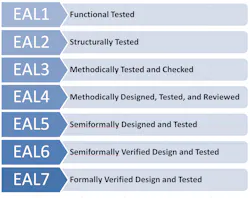
The only government-defined operating system protection profile ever designed for high robustness or EAL 6 and above is the “U.S. Government Protection Profile for Separation Kernels in Environments Requiring High Robustness” (SKPP), which was issued by the Information Assurance Directorate of the U.S. National Security Agency (NSA). To achieve High Robustness, the SKPP started with EAL 6 assurance requirements, added some EAL 7 assurance requirements necessary for High Robustness, and then extended some requirements for topics important to High Robustness that are not covered by Common Criteria.
The result was a protection profile that met the military and security information assurance needs defined by NSA-associated security analysts and security specialists from other organizations. Products that conform to the SKPP support information flow control, resource isolation, trusted initialization, trusted delivery, trusted recovery, and audit capabilities. As stated in the SKPP, “when integrated within a high-assurance security system architecture, the SKPP separation mechanisms are appropriate to support critical security policies for the Department of Defense (DoD), Intelligence Community, the Department of Homeland Security (DHS), [and] Federal Aviation Administration (FAA).”
Commercial OS that Meets EAL 6+ and High Robustness
Any operating system (OS) or hypervisor that claims to be a secure separation kernel needs to back that up with certification; otherwise, it is just marketing hype. The INTEGRITY-178 RTOS from Green Hills Software was first certified against the SKPP to High Robustness and EAL 6+ by the National Information Assurance Partnership (NIAP) in 2007 and recertified in 2011. As part of certification to the SKPP, INTEGRITY-178 underwent independent vulnerability analysis and penetration testing by the NSA to demonstrate both that it is resistant to an attacker possessing a high attack potential and that it does not allow attackers with high attack potential to violate the security policies. Green Hills Software’s latest RTOS version for multicore processors, INTEGRITY-178 tuMP, continues to meet the SKPP’s rigorous set of functional and assurance requirements for customers who need it.
The Path to No Vulnerabilities
The best way to prevent an AI cyberattack from exploiting a vulnerability before you can patch it is not to have any vulnerabilities in the first place. That sounds impossible, but t a path forward does exist. Achieving that high level of security assurance requires expert security knowledge, rigorous design, and comprehensive testing and verification. That takes time, effort, and unique skills that most projects and programs lack, even to develop a single software component, let alone all the software components. Luckily, starting with a separation kernel rated for High Robustness gets you most of the way there.
Neither the INTEGRITY-178 nor the INTEGRITY-178 tuMP separation kernels have had a single vulnerability reported since first fielding in 1997. Having no vulnerabilities also means no patches have ever been needed. Because those separation kernels meet the NSA-defined objectives for High Robustness, they guarantee data isolation, fault isolation, and controlled information flow for every software partition and the kernel itself. That guaranteed isolation provides a bulletproof foundation for a highly secure system. If an AI cyberattack finds a vulnerability in any application or network stack running on top of INTEGRITY-178 tuMP, the damage is limited to only the partition in which that application is running. All other applications in other partitions remain secure with complete confidentiality, integrity, and availability.
The new era of AI-based cyberattacks is scary. Using AI to help defend critical systems can try to match speed and capabilities with the attackers, but that will be a never-ending arms race of AI capability. Dramatically reducing the number of vulnerabilities in a system with a Zero Trust Architecture and security by design will make that defense easier and more effective. The most secure systems will use a separation kernel that meets the NSA-defined objectives for High Robustness to guarantee data isolation, fault isolation, and control of information flow between applications in different partitions. Such a system will isolate any breaches without requiring any action from the system or operator. Using a separation kernel designed rated for High Robustness may have been overkill in the past, but when defending against current and future AI cyberattacks, “overkill” can be a huge asset.