DLR aircraft flies in sync with ESA Biomass satellite to map rainforest carbon
Questions and Answers:
What was the purpose of the DLR flight campaign in Gabon? The campaign aimed to fly DLR's Dornier DO 228-212 D-CFFU in sync with ESA's Biomass satellite to collect airborne radar data for validating and calibrating the satellite's forest biomass measurements.
How did the aircraft support the Biomass mission? The aircraft carried DLR's F-SAR radar system, capturing images of the same forest areas immediately after the satellite pass. These data serve as reference measurements for fine-tuning the satellite's radar system.
What makes Biomass different from earlier radar satellites? It is the first mission to use P-band radar, with a wavelength of about 70 centimeters that can penetrate deep into vegetation and reach the forest floor. It also uses polarimetric tomography to analyze multiple forest layers.
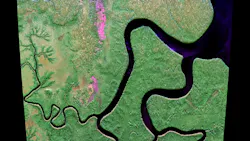
OBERPFAFFENHOFEN, Germany - The German Aerospace Center (DLR) announced it had successfully coordinated precision flight paths for its research aircraft to match the overflights of the European Space Agency's (ESA) Biomass Earth observation satellite. The aircraft used DLR's F-SAR airborne radar to acquire high-resolution images of tropical forest structure moments after the satellite passed above the same areas. The comparison data will support calibration and validation of the satellite to ensure accurate forest biomass measurements.
Synthetic aperture radar, or SAR, is an imaging technique that uses the motion of an aircraft or satellite to create high-resolution images of the Earth's surface. By combining many radar returns collected along the vehicle's flight path, SAR produces detailed two-dimensional or three-dimensional views regardless of weather or lighting conditions. It is widely used for mapping terrain, monitoring forests, tracking changes on land and ice, and supporting military and scientific remote sensing.
ESA's Biomass mission is designed to determine, for the first time, the total mass of living forest material worldwide. These measurements are critical to calculating how much carbon dioxide is absorbed, stored, or released by forests and are central to improving global warming models.
Related: German Aerospace Center and NASA collaborate on space radiation research
P-band system
To deliver reliable data, the satellite's P-band radar system, which operates at a wavelength of about 70 centimeters, must be precisely calibrated. The longer P-band wavelength allows the signal to penetrate deep into the forest canopy and reach the ground, a capability that greatly enhances estimates of forest structure and biomass. Biomass also uses polarimetric tomography to collect information from different layers of vegetation.
DLR prepared its F-SAR system by testing it near its site in Oberpfaffenhofen, Germany, using a calibration field with precisely surveyed radar reflectors. The DO 228-212 D-CFFU, operated by DLR's Flight Experiments unit, carried radar antennas on its side and underside for the mission.
DLR previously conducted similar surveys in Gabon in 2016 and 2023. Repeating the flights enables researchers to identify changes in forest biomass over time. The current campaign was conducted with the Gabonese space agency AGEOS on behalf of ESA.
With flights complete, scientists at DLR's Microwaves and Radar Institute are processing the airborne and satellite data to adjust the Biomass radar system and improve future global forest measurements.
About the Author
Jamie Whitney
Editor-in-Chief
Jamie Whitney joined the staff of Military & Aerospace Electronics in 2018 and oversees editorial content and produces news and features for Military & Aerospace Electronics, attends industry events, produces Webcasts, and oversees print production of Military & Aerospace Electronics.
Related
Voice Your Opinion!
To join the conversation, and become an exclusive member of Military Aerospace, create an account today!
 Leaders Logo
Leaders relevant to this article: