The fundamental role of standards in power design for defense
Key Highlights
- Military systems require power converters that can withstand transient spikes, surges, and environmental stresses to ensure operational reliability.
- Standards like MIL-STD-704, DO-160, and MIL-STD-1275 provide essential testing protocols for verifying power system resilience in demanding conditions.
- Modular architectures facilitate the integration of compliant components, enabling high-density, protected power solutions suitable for space-constrained military applications.
LE HAILLAN, France - Military systems demand performance and reliability, no matter what components and subsystems they use. But the trend towards electrification is placing increasing stress on the capabilities of the electronics in the power subsystems across a growing range of projects.
Avionics systems are demanding increasing levels of power to drive important flight and defense functions. The Dassault Rafale fighter aircraft employs an 80kVA generator. The design of the latest F-35 Lightning II equips the aircraft with a system capable of generating up to 160 kVA of current.
On top of conventional electronics systems to handle radar and countermeasures, defense systems are turning to increasingly advanced functions underpinned by technologies such as artificial intelligence (AI). These additional functions increase the electrical power the system requires.
These changes run alongside a growth in novel applications, such as directed-energy weapons (DEWs). These provide ways to address growing threats such as drones. DEWs provide potentially better ways to deal with them than conventional projectile weapons.
Drones themselves call for high-capability power converters. These autonomous and remotely piloted vehicles are extending the capabilities of modern forces. They range from small airborne quadcopters to large underwater vehicles.
This diversity is matched in the power systems of drones. A light airborne vehicle may use a lithium-ion battery for all its energy requirements. For higher energy densities, designers of land- and sea-borne drones may turn to internal-combustion engines to drive generators. With underwater drones, the feed from the generator is often through a cable connection from shore or ship.
In all these applications, designers need to know how well a power subsystem will withstand the demands of the application and its environment. Systems based on generators need power converters that are protected against short-lived outages and brownouts. Most systems need to protect against EMI and potential problems caused by sudden temperature changes or extreme vibration and mechanical shocks. The best way to communicate the ability of a power converter to withstand expected operating conditions is through compliance with standards.
Standards developed by dedicated groups with the backing of military organizations result from years of experience and understanding of the properties that affect performance. Standards compliance has always been important in the design of custom electronics to ensure the completed system functions as expected. But it has taken on greater importance with the growing use of commercial-off-the-shelf (COTS) subsystems. Products designed for the industrial sector share many of the same levels of efficiency and performance with those designed for military use.
But project teams using COTS need to work harder to determine how well a subsystem will function in the military environment if the product does not comply with relevant standards. Take the case of systems that draw power from a generator driven by an internal-combustion engine. In these systems, there are two risks to reliable operation. Large transients can come from engine cranking or from the changeover between different energy sources when a combustion engine runs out of fuel and shifts to backup batteries. Similarly, undervoltages and brownouts can occur during transitions or fuel interruptions.
An interruption can easily last as long as a second. By testing for the ability to withstand outages with known parameters defined by a standard, engineers can gain much greater confidence about expected performance under real-world conditions. The DO-160 and MIL-STD-704 documents specify tests to assess a power supply's ability to maintain power to the output for up to 1 second in the event of a power interruption.
MIL-STD-704 is a key standard for military aircraft, covering not just voltage stability but also transients and power quality. Because of their stringent safety requirements, civil avionics standards such as DO-160 and ABD100 can be important for helping engineers understand the capabilities of power modules and subsystems.
The requirements of military standards can be challenging. DO-160, for example, demands the ability to handle a 600 V spike on a 28 V supply. But such a spike is relatively short-lived, lasting a matter of microseconds. MIL-STD-1275, on the other hand, requires the same type of power converter to withstand surges of more than 100 V for a duration of 50 ms. The British specification DefStan 61-5 goes further, requiring power systems to withstand surges of up to 202 V for 350 ms.
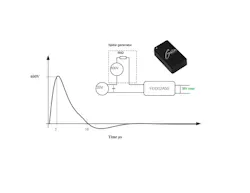
Figure 1: The waveform of the 600V transient spike test specified by DO-160G Section 17
Such stringent requirements emphasize why standards like these are so effective in helping to decide between COTS modules. Few industrial-grade modules have this capability built in. Even military-qualified converters may lack necessary internal protection devices. But modular architectures make it possible to use COTS design techniques to incorporate this level of protection that would otherwise need custom circuit design.
With a modular architecture, it is possible to compose a subsystem from a set of components that handle conversion and protection functions separately. Modules that directly support the requirements of standards like MIL-STD-1275 and DO-160 provide a straightforward path to specifying and integrating a fully protected power supply.
The modular approach can achieve the high density needed for often space-constrained military systems by using tuneable elements that integrate the required components into a single unit. An example is GAIA’s PSDG48. This single 48W three-output power-supply module integrates several protection functions, including hold-up and electromagnetic compatibility (EMC) filtering, into the same compact unit.
EMC standards are equally important in determining subsystem performance. Key standards covering both emissions and immunity levels include MIL-STD-461, DefStan 59-411, and VG 95373-20. MIL-STD-461, for example, covers the waveforms and power levels of conducted interference that compliant power converters must block to protect downstream electronics.
For environmental standards, MIL-STD-810 is an important reference. This standard establishes the conditions needed to test how well electronics will survive under temperature extremes and various humidity conditions, as well as shock and vibration.
It is important to consult the full standards; the descriptions of test conditions provide valuable insight into the relevance of a requirement to real-world conditions. Standards often also include descriptions of test fixtures and setup diagrams, which are crucial for understanding how parameters are measured and applied.
One challenge in military power supply design is efficiently locating relevant parameters within what can be extensive documents. Table 1 shows a summary of key power-related standards for typical operating voltages in ground vehicles. Specialists in the military domain, such as GAIA, can provide guidance on the key standards, identifying these and other requirements that will be important for a particular use case.
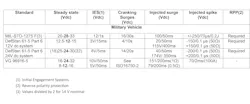
Table 1: Relevant standards for power converters in military vehicles
By referring to standards, designers can maximize their use of COTS-based modules for power and other key elements in the target system. Modular power converters, such as those developed by GAIA, accelerate time-to-market. They also deliver the assurance provided by standards compliance.
Designers risk costly redesigns and certification failures when using modules that lack tests demonstrating compliance with key standards. By adopting modules and subsystems that demonstrate compliance with military design and manufacturing standards, engineering teams can be sure they are best positioned to pass acceptance tests and deliver solid performance in the field. By engaging suppliers with a track record of engineering to standards compliance and who can highlight the relevance of each to a project, it is possible to gain much greater peace of mind.
