KULR to integrate Factorial solid-state battery technology for drone applications
Key Highlights
- The partnership aims to develop high-energy-density batteries for uncrewed aircraft systems to extend flight endurance.
- KULR will adapt Factorial's solid-state and lithium-metal cells into robust, safe, and reliable battery pack architectures.
- The collaboration supports the deployment of advanced batteries across aerospace, defense, and autonomous platforms worldwide.
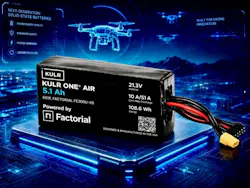
SAN DIEGO - KULR Technology Group in San Diego is integrating next-generation solid-state and lithium-metal battery cell technologies from Factorial in Billerica, Mass., into battery pack designs for uncrewed aircraft systems (UAS), the companies announced.
The effort is part of Factorial's broader initiative to accelerate deployment of advanced battery technologies across drone platforms in North America, Europe, and the Asia-Pacific region.
Under the collaboration, KULR will apply its battery-pack integration, thermal management, and safety engineering expertise to adapt Factorial's solid-state and lithium-metal battery cells for use in drone operating environments.
As military and commercial drone missions become increasingly autonomous and require longer flight times, manufacturers are seeking higher-energy-density power sources that can extend endurance without significantly increasing weight. Solid-state and lithium-metal battery technologies are viewed as potential alternatives to conventional lithium-ion batteries because they offer higher energy density, improved safety, and increased power output.
According to the companies, the integration effort focuses on developing battery-pack architectures that support high-performance UAS missions while meeting safety, reliability, and manufacturability requirements.
KULR and Factorial recently demonstrated prototype battery-pack configurations at the XPONENTIAL 2026 conference in Detroit. The companies said the systems are intended for future aerospace, defense, robotics, and autonomous-platform applications.
The initiative supports KULR's broader strategy of expanding its KULR ONE energy-storage platform into mission-critical applications requiring certification readiness, thermal management, and operational safety. The company's KULR ONE Air platform is being developed for drone, advanced air mobility, electric aircraft, and other aviation applications.
Factorial is developing solid-state and lithium-metal battery technologies designed to increase energy density while reducing the limitations associated with conventional lithium-ion cells. The company has been working with automotive and aerospace manufacturers to advance commercialization of next-generation battery systems.
