Amprius introduces SiCore 500
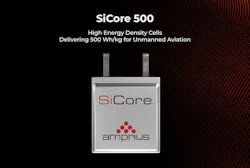
FREMONT, Calif. - Amprius Technologies Inc. introduced a silicon-anode lithium-ion battery cell rated at 500 watt-hours per kilogram (Wh/kg) for long-endurance aviation applications. The second-generation SiCore cell delivers the specified energy density at a continuous 1C discharge rate and is designed for production using conventional lithium-ion battery manufacturing equipment.
The company said previous cells reaching 500 Wh/kg required specialized materials handling and nonstandard construction. The second-generation SiCore platform is designed to achieve the same specific energy using existing manufacturing equipment, processes, and cell formats across Amprius' contract manufacturing network.
The cell targets high-altitude platform stations (HAPS), fixed-wing uncrewed aircraft, and other applications requiring extended flight endurance. Higher cell-level specific energy can reduce battery mass for a given energy capacity or provide more stored energy within a given weight limit, potentially increasing aircraft endurance, range, or payload capacity.
Amprius has supplied batteries to AALTO, an Airbus subsidiary developing solar-electric HAPS aircraft, since 2018. The company's silicon-anode cells powered AALTO's Zephyr aircraft during a 2025 flight that lasted 67 days, 6 hours, and 52 minutes, setting an endurance record for continuous aircraft flight. Zephyr uses solar panels to recharge its batteries during daylight and stored electrical energy to sustain flight overnight.
Amprius expects to make the second-generation SiCore cell commercially available in the fourth quarter of 2026. The company plans initial production at its Fremont facility, with volume production expected to expand through existing contract manufacturing partners. Cells are expected to be available in customer-specific configurations and a standard small uncrewed aircraft systems (sUAS) pouch format defined by SAE JA1016.
For more information, visit ir.amprius.com.