MOSFET devices for power electronics in industrial and automotive applications introduced by Infineon
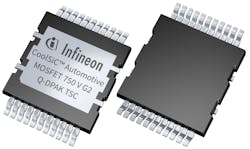
Summary points:
- Infineon Technologies AG introduces CoolSiC 750V G2 MOSFETs in Q-DPAK and D2PAK packages to boost efficiency and power density in industrial and automotive power conversion systems.
- Low RDS(on) options from 4 to 60 milliohms enable high-performance designs for server and telecom SMPS, EV charging, onboard chargers, and HV-LV DC-DC converters.
- Top-side cooled Q-DPAK package enhances thermal performance and reliability, supporting high-power uses such as eFuses, battery disconnect switches, solid-state circuit breakers, and relays.
MUNICH – Infineon Technologies AG in Munich is introducing packages for the CoolSiC metal oxide silicon field-effect transistor (MOSFET) 750-volt G2 technology to deliver system efficiency and power density in industrial and automotive power conversion applications.
This is available in packages like Q-DPAK and D2PAK, offering a portfolio with typical RDS(on) values up to 60 milliohms at 25 degrees Celsius.
This includes products for applications like server and telecommunications switch-mode power supply and EV charging infrastructure and automotive onboard chargers and HV-LV DCDC converters.
Solid-state relays
The ultra-low RDS(on) values of 4 milliohms enables applications that require static-switching performance like eFuse, high-voltage battery disconnect switches, solid-state circuit breakers, and solid-state relays.
One of the key features of the CoolSiC MOSFET 750-volt G2 technology is its top-side cooled Q-DPAK package, which provides thermal performance and reliability. This package handles high-power applications.
The CoolSiC MOSFET 750-volt G2 Q-DPAK 4/7/20/33/40/50 milliohms and D2PAK 7/25/33/40/50/60 milliohms samples are available now. For more information contact Infineon online at www.infineon.com/product-information/power/mosfet/silicon-carbide/750v.