Exxelia introduces new high-temp polypropylene film capacitor series
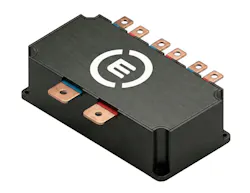
BOULOGNE-BILLANCOURT, France - Exxelia in Boulogne-Billancourt, France, has introduced a new high-temperature polypropylene film capacitor series, the CF-PP140, targeting power-dense, thermally constrained environments in aerospace, mobility, and industrial power electronics.
The CF-PP140 line is designed to extend the operating envelope of polypropylene (PP) dielectric technology while preserving its high energy-storage efficiency. According to the company, the capacitors support voltage ratings from 450 V to 1500 V and achieve energy densities up to 250 J/L in optimized configurations, positioning the series for compact, mission-critical power systems where both thermal headroom and volumetric efficiency are limiting factors.
The CF-PP140 series incorporates self-healing dielectric behavior, a standard characteristic of advanced film capacitors in which localized dielectric breakdowns are isolated and cleared without catastrophic failure. This mechanism is intended to improve long-term reliability under high electrical stress, particularly in environments with elevated thermal cycling and vibration.
The devices are offered in standardized footprints to simplify adoption in dense power electronics architectures. Exxelia also offers customization pathways that integrate the CF-PP140 element with Exxelia SVM's proprietary busbar structures into higher-level assemblies branded as "Power Blocks." These assemblies are intended to reduce packaging complexity and streamline mechanical and electrical integration in tightly constrained systems.
The company positions the CF-PP140 for applications including uncrewed aerial systems (UAS), electric vertical takeoff and landing aircraft (eVTOL), and heavy-duty electrified vehicles such as agricultural machinery.
In a dielectric comparison framework, CF-PP140 sits between traditional polypropylene and higher-temperature polymer film technologies. It maintains higher energy density than polyester (PET) or polyphenylene sulfide (PPS) while delivering better volumetric efficiency than high-temperature polymers such as polyetherimide (PEI) or polytetrafluoroethylene (PTFE). The trade-off is intended to optimize compactness without fully sacrificing the dielectric efficiency typically associated with polypropylene systems.
The company describes the CF-PP140 as part of a broader trend in power electronics toward higher-temperature operation and increased power density, driven by electrification in aerospace and mobility platforms where cooling capacity and available volume are both constrained.
For more information, please visit https://exxelia.com.