Pickering introduces LXI high-current switching family for signals up to 80 A and 300 V
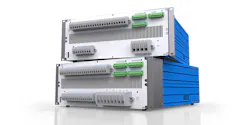
TEWKSBURY, Mass. - Pickering Interfaces has introduced the 60-191 family of LXI high-current switching units for automated test systems that need to distribute and control multiple high-current power supplies.
The 4U rack-mount units combine high-current power switching with low-current sense-line switching. The family can switch signals up to 80 amps and 300 volts and provides programmatic control of power-supply positive and negative outputs, along with associated high- and low-sense lines.
The 60-191 family uses hermetically sealed, single-pole, single-throw normally open contactors for high-current switching and 1-amp SPST relays for sense lines. Configurations support up to ten 40-amp power supplies or two 80-amp power supplies, with separate switching for each supply's positive and negative outputs. Connections are made through front-panel screw terminals.
Engineers can control individual relays or group the two high-current and two low-current relays associated with a power supply into a single command. This provides coordinated switching of the four connections used for the supply's positive, negative, high-sense, and low-sense lines.
The units include built-in sequence storage capable of holding up to 5,000 predefined switching sequences. Sequences can be initiated through software or hardware triggers, allowing test engineers to load switching operations into the unit and execute them without issuing each individual switching command from the host system.
The 60-191 uses an LXI 1.5-compliant 1000Base-T Ethernet interface and supports control through an application programming interface or software front panel. IVI and direct I/O drivers support Windows and Linux, as well as development environments including LabVIEW, Python, C/C++, C#, MATLAB, and Simulink.
Front-panel LEDs indicate relay status, while relay cycle counting provides information to monitor relay usage and plan maintenance.
Potential applications include aerospace development, high-current power-supply testing, electric-vehicle battery and automotive electronics testing, fuel-cell and hydrogen-electrolysis research, solar inverter testing, and energy-storage systems.
For more information, please visit https://www.pickeringtest.com.