IrvinGQ to build maritime electronic warfare (EW) radar decoys to protect naval surface warships
Key Highlights
Questions and answers:
- What company received the recent contract for the MK-59 IrvinGQ Ltd. in Llangeinor, Wales, was awarded a $24.8 million contract by the Naval Sea Systems Command for follow-on production, with work completing by December 2026.
- How does the MK-59 function in naval defense The octahedral corner reflector decoy drifts to confuse enemy radar, sonar, and missile systems, augmenting chaff, electronic warfare, and CIWS in layered defenses.
- What is the history and deployment of the MK-59 Evolved from DLF-series models post-Falklands War in 1982, the U.S. Navy has used it on destroyers since 2013, launched independently without further ship input.
WASHINGTON – U.S. Navy surface warfare experts needed ways to spoof enemy radar-guided anti-ship missiles. They found a solution from IrvinGQ Ltd. in Llangeinor, Wales.
Officials of the Naval Sea Systems Command in Washington announced a $24.8 million contract to IrvinGQ last Wednesday for follow-on production of the MK-59 Floating Decoy System.
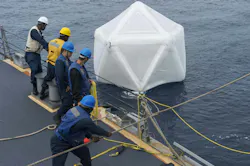
The MK-59 is a passive radar decoy deployed from deck-mounted tubs aboard Arleigh Burke-class destroyers. The octahedral corner reflector decoy self-inflates on the ocean surface, and drifts to mimic a ship's radar signature to distract anti-ship missiles.
The radar decoy remains afloat for as long as three hours in waves as high as four to eight feet. The decoy requires no further ship input after deployment.
Layered defenses
The system augments layered defenses like chaff and electronic warfare (EW) in shallow coastal waters and harbors against radar-guided anti-ship missiles. It evolved from earlier DLF-series models tested after the Falklands War in 1982 The U.S. Navy has used the decoy aboard destroyers since 2013.
The MK-59 is designed to confuse and mislead enemy radar, sonar, and missile systems to protect naval vessels from incoming threats like anti-ship missiles or torpedoes.
It consists of floating, radar-reflective buoys or decoy units that simulate the electronic signature of the ship they are protecting or any other target. The idea is to draw the enemy's targeting system away from the real vessel to give the ship a chance to avoid or defend against an incoming attack.
The MK-59 works against radar-guided missiles, sonar systems, and electromagnetic tracking. Ship crews deploy it when their ships are at risk of being attacked by surface-to-air or air-to-surface missiles.
Integrated shipboard defense
The system typically deploys as part of broader defensive measures such as chaff and flares, and integrated with other shipboard defense systems like Close-In Weapon Systems (CIWS).
The MK-59 helps to mask the ship's position and protect it from detection. This form of electronic deception is a core component of surface warships ability to defend themselves against fast and stealthy threats.
On this contract, IrvinGQ will do the work in Bridgend, Wales; West Fargo, N.D.; York, England; Bloomfield, Conn.; and other locations, and should be finished by December 2026. For more information contact IrvinGQ online at www.irvingq.com/products/naval-decoy-systems, or Naval Sea Systems Command at www.navsea.navy.mil.
