Navy taps Northrop Grumman for electronic warfare (EW) and missile defense for surface warships
Key Highlights
Questions and answers:
- What is the total value of the U.S. Navy’s contract with Northrop Grumman for the SEWIP Block 3 systems? The total value of the contract so far is $783 million.
- What new technology does the SEWIP Block 3 use to improve ship defense capabilities? It uses active electronically scanned array (AESA) antennas with gallium nitride (GaN) transmit and receive modules for enhanced detection, jamming, and threat response.
- What is the main purpose of the SEWIP program? The program aims to upgrade the Navy’s existing AN/SLQ-32 electronic warfare system to improve missile defense and situational awareness on surface warships.
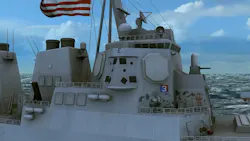
WASHINGTON – U.S. Navy surface warfare experts are ordering advanced electronic warfare (EW) systems equipment for guided missile destroyers, aircraft carriers, and amphibious assault ships under terms of a $334.4 million order announced Wednesday.
Officials of the Naval Sea Systems Command in Washington are asking engineers at the Northrop Grumman Corp. Mission Systems segment in Linthicum Heights, Md., to build Surface Electronic Warfare Improvement Program (SEWIP) Block 3 hemisphere and quadrant systems.
The SEWIP shipboard electronics system is an evolutionary acquisition program to upgrade the existing AN/SLQ-32(V) EW system for surface warships and provide improved anti-ship missile defense and situational awareness. This order brings the contract's total value so far to $783 million.
Northrop Grumman won $267 million Navy contract in 2015 to develop and build SEWIP Block 3 to make further upgrades to the AN/SLQ-32 with new technologies for early detection, signal analysis, threat warning, and protection from anti-ship missiles. There are three established SEWIP block upgrades and a fourth is planned.
Hemisphere and quadrant configurations
Hemisphere and quadrant refer to production configurations of SEWIP Block 3; they have different array arrangements for AESA coverage on Navy surface warships.
SEWIP Block 3 uses 16 AESA arrays, split into four quadrants; each quadrant has four transmit-and-receive faces. Two receive, and two transmit for 360-degree threat response.
Quadrant systems emphasize four-quadrant coverage, and align with destroyer sponsons that nest between AN/SPY-1 radar faces, and feature diamond-shaped enclosures that are about 22 feet tall. Hemisphere variants adapt for half-sphere coverage suited to different vessel classes or installation locations.
The SEWIP Block 3 uses active electronically scanned array (AESA) antennas based on gallium nitride (GaN) transmit and receive modules. The system not only jams enemy targeting radars and missile guidance systems, but also has a Soft Kill Coordinator (SKC) to manage electronic-attack engagements.
Soft kill
Soft kill refers to altering the electromagnetic signature of friendly ships and other targets to confuse or interfere with enemy radar targeting systems.
The Lockheed Martin Rotary and Mission Systems segment in Liverpool, N.Y., is building the SEWIP Block 2 surface warfare EW system, which provides improved electronic support receivers and combat system interface and expands the receiver and antenna group to help surface electronic warfare capabilities keep pace with growing threats.
Since the SEWIP program started in 2002, General Dynamics Advanced Information Systems (AIS) in Fairfax, Va., acted as prime contractor for SEWIP blocks 1A, 1B1, 1B2, and 1B3.
Passive radar
Developed by Raytheon in the 1970s, the original AN/SLQ-32 systems employed passive radar technology for early warning, identification and tracking of enemy threats. Subsequent upgrades provided an additional active capability for simultaneous jamming of several different threats.
On this contract Northrop Grumman will do the work in Baltimore, Chelmsford, and Sykesville, Md.; Tampa, Fla.; San Diego; Hudson and Nashua, N.H.; Woburn, Mass.; Rochester, N.Y.; Glendale, Ariz.; Denver and Longmont, Colo.; Washington, N.C.; Cincinnati; and other locations, and should be finished by December 2029. With options, the order could last through April 2030.
For more information contact Northrop Grumman Mission Systems online at www.northropgrumman.com/what-we-do/mission-solutions/electronic-warfare/surface-electronic-warfare-improvement-program-sewip, or Naval Sea Systems Command at www.navsea.navy.mil.
