Northrop Grumman to tackle digital beamforming ASIC for RF and microwave uses like EW and radar
Key Highlights
Questions and answers:
- What is the VEYRON project developing? A digital beamforming transceiver ASIC for enhanced radar and communications signal processing.
- Which company received the $60 million contract for VEYRON? Northrop Grumman Mission Systems in Linthicum Heights, Md.
- What are two key security focuses of the VEYRON project? Mitigating supply chain vulnerabilities like tampering and counterfeiting, and integrating on-chip root of security technology.
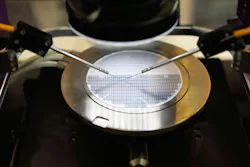
WRIGHT-PATTERSON AFB, Ohio – U.S. Air Force sensors experts needed a digital beamforming transceiver application-specific integrated circuit (ASIC) for enhanced signal processing of radar and communication signals. They found a solution from Northrop Grumman Corp.
Officials of the Air Force Research Laboratory Sensors Directorate at Wright-Patterson Air Force Base, Ohio., announced a $60 million contract in December to the Northrop Grumman Mission Systems segment in Linthicum Heights, Md., for the VEYRON project of the Air Force's Microelectronics Innovation for Next-generation System Advancement and Validation (MINSAV) program.
VEYRON focuses on advanced microelectronics research for RF and microwave defense applications by developing a digital beamforming transceiver ASIC for enhanced radar and communications signal processing. VEYRON also seeks to integrate supply chain vulnerability mitigation using on-chip root of security technology.
The project seeks to create a secure digital beamforming ASIC that enhances signal directionality and timing control for systems like radar, electronic warfare (EW), communications, and sensors. It focuses signals directly to receivers to improve security in military communications channels.
Microelectronics security
Security parts of VEYRON seeks to mitigate supply chain vulnerabilities such as risks of tampering, counterfeiting, and other threats from global semiconductor sourcing in efforts to ensure integrity in custom-designed circuits for military systems.
The MINSAV effort seeks to acquire the design and fabrication of commercial and government developed signal generation and processing technologies to enhance U.S. commercial microelectronics technologies and align these with military needs.
MINSAV will build prototypes to demonstrate microelectronics capabilities for machine autonomy; artificial intelligence (AI); position, navigation, and timing (PNT); EW; and data processing. The project also seeks to protect chips from attempts to steal military intellectual property; as well as malicious tampering during design. MINSAV seeks to facilitate rapid modernization of existing military systems with cutting-edge microelectronics components.
On the VEYRON contract, Northrop Grumman will do the work in Linthicum Heights, Md., and should be finished by June 2028. For more information contact Northrop Grumman Mission Systems online at www.northropgrumman.com/who-we-are/business-sectors/mission-systems, or the Air Force Research Laboratory Sensors Directorate at www.afrl.af.mil/RY.