Navy orders four MV-22B tiltrotor aircraft with avionics and flight-control systems for the Marine Corps
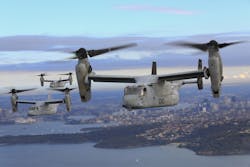
PATUXENT RIVER NAS, Md. – U.S. military aviation officials are ordering four versions of the V-22 tiltrotor aircraft and avionics from the Bell-Boeing Joint Project Office (JPO) in St. Louis under terms of a $302.2 million order announced Friday.
Officials of the U.S. Naval Air Systems Command at Patuxent River Naval Air Station, Md., are asking the Bell-Boeing JPO to build four MV-22B aircraft for the U.S. Marine Corps.
The Bell-Boeing JPO is a joint venture of Bell Helicopter in Fort Worth, Texas, and the Boeing Co. Defense, Space & Security segment in St. Louis.
The V-22 Osprey uses tiltrotor technology to combine the vertical performance of a helicopter with the speed and range of a fixed-wing aircraft. It features vertical take-off and landing (VTOL) and short take-off and landing (STOL) capabilities, and is designed long-range high-speed missions.
Related: Avionics upgrades set for 9 Marine Corps MV-22 aircraft
The aircraft has a weather radar, a forward firing ALE-47 airborne countermeasures dispenser system, improved hover coupled features, and an improved environmental conditioning system, compared to earlier versions of the tiltrotor.
The V-22 has a glass cockpit with four multi-function displays that are compatible with night-vision goggles, and one shared central display unit to display various images including: digital maps, imagery from the turreted forward-looking infrared system, primary flight instruments, navigation, and system status.
The tiltrotor aircraft has triple-redundant fly-by-wire flight control with computerized damage control to isolate damaged areas automatically.
The V-22 Osprey is a joint service, multirole combat aircraft that uses tiltrotor technology to combine the speed and range of a fixed-wing airplane with the vertical performance of a helicopter.
With its nacelles and rotors in vertical position, it can take off, land, and hover like a helicopter. Once airborne, its nacelles rotate forward to transform the aircraft into a turboprop airplane capable of high-speed and high-altitude flight.
The Marine Corps MV-22B transports warfighters, equipment, and supplies from ships and land bases for combat assault and assault support.
Related: L3Harris to provide EW for Special Operations aircraft
The aircraft also supports naval missions like combat search and rescue, fleet logistics support, special warfare support, amphibious assault, ship-to-objective maneuvers, and sustained operations ashore. The MV-22B can transport 24 combat troops and 20,000 pounds of internal cargo, or 15,000 pounds of external cargo.
On this order Bell-Boeing will do the work in Fort Worth, McKinney, and Red Oak, Texas; Ridley Park, Pa.; East Aurora and Endicott, N.Y.; Park City, Utah; and in other locations inside and outside the continental U.S., and should be finished by November 2025.
For more information contact the Bell-Boeing JPO online at www.bellflight.com/products/bell-boeing-v-22, or Naval Air Systems Command at www.navair.navy.mil.
