Army orders AH-64E attack helicopters, digital communications, and data networking in $4.7 billion deal
Key Highlights
Questions and answers:
- What is the purpose of the $4.7 billion Army contract with Boeing? To build new AH-64E Apache Guardian attack helicopters, Longbow crew trainers, components, spare parts, and accessories for the U.S. Army.
- What major upgrades distinguish the AH-64E Apache Guardian from earlier versions? Upgraded T700-GE-701D engines, digital connectivity via the Joint Tactical Radio System (JTRS), composite rotor blades, improved radar and targeting sensors, UAV control capability, and enhanced survivability and maintainability.
- How does the Army employ the AH-64E Apache in combat operations? For precision-attack, armed reconnaissance, and close-combat missions under all conditions.
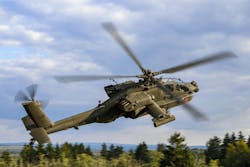
REDSTONE ARSENAL, Ala. – Military helicopter experts at the Boeing Co. will provide the U.S. Army with new-build AH-64E Apache Guardian attack helicopters under terms of a $4.7 billion contract announced last week.
Officials of the Army Contracting Command at Redstone Arsenal, Ala., are asking the Boeing Defense, Space & Security segment in Mesa, Ariz., for new-build Apache AH-64E attack helicopters, Longbow crew trainers, components, spare parts, and accessories.
The AH-64 Apache is a multirole combat helicopter with integrated avionics and weapons, as well as digital communications to enable real-time, secure transfer of battlefield information to air and ground forces.
The AH-64E Apache Guardian features enhanced performance, joint digital operability, improved survivability and cognitive decision aiding, and reduced operating and support costs, Boeing officials say. The AH-64E Apache, is being delivered to the U.S. Army and has been selected by several international defense forces.
Modernized radar
The AH-64E Longbow manufacturing effort involves the Longbow Limited Liability Co. (LBL) joint venture between Northrop Grumman Corp. and Lockheed Martin. Lockheed Martin provides the Modernized-Radar Frequency Interferometers (MRFI) and the Hellfire missile, which provides fire and forget capabilities. Northrop Grumman provides the AN/APG-78 millimeter wave fire-control radar.
The combination of the attack fire-control radar, frequency interferometer, and the navigation and communications avionics provides increased situational awareness, lethality, and survivability, Army officials say.
This program also installs the Lockheed Martin Apache Arrowhead Modernized Target Acquisition Designation Sight (M-TADS) and Pilot Night Vision Sensors (PNVS) systems aboard new AH-64E helicopters.
Formerly known as AH-64D Block III, the AH-64E Guardian has improved digital connectivity, the joint tactical radio system (JTRS), more powerful T700-GE-701D engines with upgraded transmission to accommodate more power, capability to control unmanned aerial vehicles (UAVs), new composite rotor blades, instrument flight rules (IFR) capability, and improved landing gear.
Tell me more about how the Army uses the AH-64E attack helicopter in combat ...
- The Army uses the AH-64E Apache helicopter primarily for high-performance precision-attack missions, including armed reconnaissance, close combat, and mobile strike roles in day, night, and bad weather. It features sensors, targeting systems, and a networked architecture for real-time data sharing with ground forces and other units. The AH-64E excels in destroying armored vehicles, personnel, and materiel targets at ranges up to eight kilometers, using a 30-millimeter chain gun, Hellfire missiles, guided rockets, and counter-drone capabilities. It also conducts vertical maneuvering and supports multi-domain operations by penetrating enemy defenses and providing deep fires. Its survivability is enhanced by radar and missile warning systems and infrared suppressors, reflecting lessons from recent conflicts. The AH-64E is central to the Army's updated aviation doctrine and modernization efforts in offensive aviation.
The AH-64E is designed for armed reconnaissance, close combat, mobile strike, and vertical maneuver missions in day, night, obscured-battlefield, and adverse-weather conditions. The helicopter has self-diagnostic abilities, Link-16 data networking, and updated Longbow radar with oversea capacity that could enable naval strikes.
Versions of the AH-64 Apache attack helicopter have been in service with the U.S. Army since 1986. It is a four-blade, twin-engine attack helicopter with a tandem cockpit for a two-man crew.
It has a nose-mounted sensor suite for target acquisition and night vision systems. It is armed with a 30-millimeter M230 Chain Gun carried between the main landing gear, under the aircraft's forward fuselage.
Hardpoints for weapons
The attack helicopter has four hardpoints mounted on stub-wing pylons, typically carrying a mixture of AGM-114 Hellfire missiles and rockets. The helicopter was designed to replace the Bell AH-1 Cobra as the Army's primary attack helicopter. The U.S. Marine Corps still operates late-model versions of the AH-1 Cobra.
Boeing began deliveries of the AH-64E model in October 2011. Seven customers outside the U.S. have ordered this variant. The U.S. and 15 other countries have used the Apache during the past three decades.
On this order Boeing will do the work in Mesa, Ariz., and should be finished by May 2032. For more information contact Boeing Defense, Space & Security online at https://www.boeing.com/defense/ah-64-apache#overview, or the Army Contracting Command-Redstone at https://acc.army.mil/contractingcenters/acc-rsa/.
