Marines asks BAE Systems for 30 more amphibious armored combat vehicles, with vetronics and sensors
Key Highlights
Questions and answers:
- What is the primary purpose of the Amphibious Combat Vehicle (ACV) for the U.S. Marine Corps? To transport Marine infantry from ships offshore to invasion beaches and provide direct fire support during amphibious assaults.
- Which company is producing the new ACVs, and what is the potential value of the contract? BAE Systems Platforms & Services is building the vehicles under a contract that could reach as much as $3.9 billion.
- What types of sensors are integrated into the ACV to enhance battlefield performance? cameras, thermal imagers, laser rangefinders, and chemical, gas, and radiation sensors to provide 360-degree situational awareness, target acquisition, and battlefield monitoring.
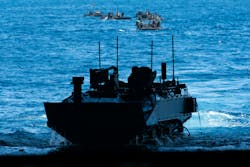
QUANTICO, Va. – U.S. Marine Corps amphibious warfare experts are ordering another 30 amphibious armored combat vehicles and accompanying vetronics to replace the Corps's ageing fleet of amphibious assault vehicles (AAVs).
Officials of the Marine Corps Systems Command at Quantico Marine Base, Va., announced a $184.4 million order Monday to the BAE Systems Platforms & Services segment in Sterling Heights, Mich., for 30 full-rate-production medium-caliber cannon mission role Amphibious Combat Vehicle (ACV) variants. The contract could be as much as $3.9 billion.
ACVs are wheeled armored combat vehicles that to move Marine Corps infantry from ships offshore to fight their way onto invasion beaches. The Marine Corps could end up purchasing as many as 204 vehicles over the next few years to outfit some of its 10 amphibious assault companies — the first phase of an incremental approach to replacing the AAV, which entered service in 1972.
BAE Systems delivered the first vehicles in November 2019 to the 1st Marine Division. The first batch of 18 ACVs went to a platoon of the 1st Marine Division's 3rd Assault Amphibian Battalion at the Marine Corps Air Ground Combat Center in Twentynine Palms, Calif.
Italian roots
BAE Systems engineers base their ACV design on the Superav 8x8 amphibious armored personnel carrier developed by the Italian company Iveco Defence Vehicles.
ACV systems are designed to operate through enemy direct fire, indirect fire, and land mines with low-profile visual and infrared signatures, modular protection, and other armored vehicle technologies.
The vehicles can swim to shore from as far as 12 miles out to sea, switch from operating in the water to ground operations without pause, and then maneuver with M1 Abrams main battle tanks in a mechanized task force. The ACV can destroy relatively light enemy combat vehicles similar to itself.
Vetronics are a key components of the ACV for communications, navigation, vehicle management, and sensors. Communications systems consist of radios, an intercom system, and digital data links. Navigation and positioning vetronics use GPS satellite navigation, inertial navigation, and terrain mapping and obstacles avoidance.
The ACV's vehicle management vetronics include vehicle diagnostics and health monitoring of the engine, transmission, suspension, and electrical systems. Onboard sensors include gas, radiation, and chemical sensors; cameras and thermal imaging for enhanced visibility; and laser rangefinders and targeting systems to engage targets at long range.
Tell me more about sensors aboard the U.S. Marine Corps Amphibious Combat Vehicle ...
- The Amphibious Combat Vehicle uses a network of sensors to boost situational awareness, fire control, and mobility. Key onboard sensors included a stabilized remote weapon station that integrates a day video camera, thermal imager, and laser rangefinder for day/night target acquisition and engagement on the move external camera arrays and a modern digital interface give the crew enhanced 360-degree awareness compared with legacy AAVs; the ACV-C command variant adds several radios and antenna/sensor suites to support data sharing and battle management; and the design allows growth for future sensors such as reconnaissance, electronic warfare payloads, and unmanned systems integration.
The ACV's integrated fire control system includes its primary gun systems and other mounted weapons, which can be automated or manually controlled by the crew. Automated ammunition handling helps manage ammunition and ensure rapid reloading during combat.
ACV vetronics also include systems to manage its transition from land to water and vice versa, ensuring stability and propulsion while afloat, as well as systems for controlling its water propulsion and maintaining its buoyancy during amphibious operations.
The vehicle's cyber security and encryption vetronics protect its communications, navigation, and control systems from hacking or electronic warfare (EW) threats, while crew interface and display vetronics present information about the vehicle’s status, the tactical environment, and mission data.
Fire support
The ACV will provide direct fire support for Marine infantry, and can carry 17 Marines at speeds of at least eight knots at sea amid waves as high as three feet.
On shore, the ACV has high-ground clearance and a V-shaped hull to resist the effects of land mine blasts, and can operate with a wheel blown off. Each ACV has a crew of three, an M2 .50 caliber machine gun in a remote weapons station, with the potential to install a stabilized dual-mount M2/Mark 19 grenade launcher turret.
On this order BAE Systems will do the work in York, Pa.; Aiken, S.C.; San Jose, Calif.; Sterling Heights, Mich.; and Stafford, Va., and should be finished by March 2028. For more information contact BAE Systems Platforms & Services online at www.baesystems.com/en-us/our-company/inc-businesses/platforms-and-services, or Marine Corps Systems Command at www.marcorsyscom.marines.mil.
