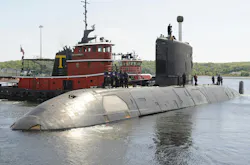
WASHINGTON – Canadian attack submarines will undergo an upgrade to their underwater-detection capabilities under terms of a $15.5 million foreign military sales contract announced last week to Delphinus Engineering in Newtown Square, Pa.
Officials of the U.S. Naval Sea Systems Command are asking Delphinius Engineering to develop, integrate, and test bow array sonar and lift systems aboard the Canadian fleet of four Victoria-class submarines.
Canadian Victoria-class submarines originally were Upholder-class diesel-electric submarines built in the United Kingdom during the 1980s for the Royal Navy, and were acquired by Canada in 1998 to replace that country's Oberon-class submarines.
Bow array and lift systems
The Victoria-class bow array and lift system are key components of the submarine's sonar suite that helps enable the vessel to detect, classify, and localize potentially hostile enemy submarines in and around Canadian waters.
The bow array is a hull-mounted sonar that can track as many as 12 underwater objects like submarines. Recent upgrades involve a new U.S.-built Victoria Class Bow Array (VCBA) from Delphinus Engineering.
The lift system deploys and retract's the Victoria-class submarine's bow sonar array to make room for firing torpedoes. The vessel's torpedo tubes sit above the array, and complicate traditional torpedo crane-loading methods.
Tell me more about electronics aboard Canadian Victoria-class submarines ...
- Canadian Victoria-class submarines feature upgraded electronics from their United Kingdom Upholder origins, including Canadian communication gear and electronic support measures (ESM) with AR 900 and two SSE decoy launchers. Key systems include Kelvin Hughes Type 1007 radar, Thales Type 2007 flank array sonar, Type 2046 towed array with integrated CANTASS, and Lockheed Martin Librascope SFCS fire control from Oberon-class integration. Periscopes use CK035 electro-optical search and CH085 optronic attack models, while power relies on GEC alternators and motors; early DC issues were resolved.
Victoria-class submarines feature a teardrop-shaped, single-skinned hull made from high-tensile NQ1 steel, coated with elastomeric acoustic tiles to minimize the possibility of enemy detection. They measure 70.3 meters long, with a beam of 7.6 meters and a draught of 5.4 meters, and displace about 2,200 tons surfaced and 2,455 tons submerged.
These 1980s-vintage diesel-electric submarines can reach speeds as fast as 12 knots on the surface, and as fast as 20 knots while submerged. They can stay at sea for as long as 56 days and reach depths of about 200 meters. Victoria-class submarines carry as many as 18 Mark 48 torpedoes, supporting stealthy surveillance and combat roles.
On this contract Delphinus Engineering will do the work in Newtown, Pa., and should be finished by July 2030. For more information contact Delphinius Engineering at www.delphinus.com, Naval Sea Systems Command at www.navsea.navy.mil, or the Royal Canadian Navy at www.canada.ca/en/navy/corporate/fleet-units/submarines/victoria-class.html.