Navy plans to order nearly 200 new F-35 combat jets, avionics, and sensors in $1.1 billion deal
Key Highlights
Questions and answers:
- Who awarded Lockheed Martin the $1.1 billion order for new F-35 fighters? The U.S. Naval Air Systems Command at Patuxent River Naval Air Station awarded the order.
- How many new F-35 aircraft are involved in this order? The order covers long-lead materials for 198 new F-35 jets.
- What is one key feature of the F-35 pilot’s helmet display system? The helmet enables pilots to target and fire weapons simply by looking at the target rather than pointing the entire aircraft.
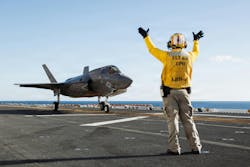
PATUXENT RIVER NAS, Md. – Combat jet designers at Lockheed Martin Corp. are preparing to build nearly 200 new F-35 joint strike fighter aircraft for the U.S. Navy, Air Force, Marine Corps, and foreign allies under terms of a $1.1 billion order announced last week.
Officials of the Naval Air Systems Command at Patuxent River Naval Air Station, Md., are asking the Lockheed Martin Aeronautics segment in Fort Worth, Texas, for parts and long-lead materials for 198 new F-35 combat jets.
These parts and long-lead items are for 65 lot 20 F-35s, and for 133 lot 21 F-35s for the Air Force, Navy and Marine Corps, F-35 cooperative program partners, and Foreign Military Sales (FMS) customers.
Long-lead materials often are expensive and take a long time to produce, and are acquired early to maintain production schedules. Contracts for the actual aircraft will come later.
International operators
Other than the U.S. military, F-35 operators today or planned for the future are the United Kingdom, Italy, the Netherlands, Australia, Norway, Israel, Japan, South Korea, Singapore, Denmark, and Belgium.
The United Kingdom operates F-35Bs from aircraft carriers and land bases, with 41 delivered out of planned totals. Italy fields F-35As and F-35Bs at several land bases. The Netherlands has about 46 operational F-35As. Australia runs at least 72 F-35As, while Norway completed its 52 F-35A fleet in 2025. Israel operates more than 40 modified F-35I Adir jets; Japan and South Korea have more than 27 and 39 F-35As respectively. Singapore has eight F-35s on order, and the F-35 fleets of Denmark and Belgium are not yet fully operational.
The F-35 with its advanced avionics is a fifth-generation single-seat, single-engine, all-weather stealth multirole jet fighter-bomber designed to perform ground attack, aerial reconnaissance, and air defense missions. It is one of the most advanced combat jets in the world.
The F-35's avionics and sensors include the Northrop Grumman AN/APG-81 AESA radar; Lockheed Martin AAQ-40 electro-optical targeting system (EOTS); Northrop Grumman AN/AAQ-37 distributed aperture system (DAS) missile warning system; BAE Systems AN/ASQ-239 electronic warfare (EW) suite; and Northrop Grumman AN/ASQ-242 communications and navigation system.
Navigation and communications
The plane's navigation and communications include the Harris Corp. Multifunction Advanced Data Link (MADL); Link 16 data link; single-channel ground and airborne radio system (SINCGARS); IFF interrogator and transponder; HAVE QUICK radio; AM, VHF, UHF AM, and UHF FM radio systems; GUARD survival radio; radar altimeter; tactical air navigation (TACAN); instrument landing system for conventional runways and aircraft carriers; the Joint Precision Approach and Landing System (JPALS); and the TADIL-J tactical digital information link with Joint-Variable-Message-Format (JVMF) communications.
F-35 pilots wear a helmet-mounted display that enables them simply to look at a target to shoot weapons, rather than pointing the entire aircraft at the target. The orientation of the pilot's head provides missile seeker heads with targeting information.
The F-35 is replacing U.S. F-16, A-10, F/A-18, and AV-8B tactical fighter and attack aircraft. Lockheed Martin has been developing the F-35 since 2001.
The single-seat F-35 military jet is 50.5 feet long, has 35-foot wingspan, and is 14 feet tall. It has one Pratt & Whitney F135 afterburning turbofan engine that can produce as much as 43,100 pounds of thrust.
Mach 1.6
The aircraft can fly as fast as Mach 1.6, as high as 50,000 feet, and has a range of 1,200 miles. It has one 25-millimeter Gatling gun and can carry advanced air-to-air missiles, air-to-ground missiles, smart bombs, and conventional bombs.
The combat aircraft -- one of the most expensive military weapon systems in history -- is designed to perform ground attack, aerial reconnaissance, and air-to-air missions. U.S. military leaders say they plan to buy 2,457 aircraft.
The F-35 variants are intended to provide the bulk of the manned tactical air power of the U.S. Air Force, Navy, and Marine Corps. Deliveries of the F-35 for the U.S. military are scheduled to be completed in 2037.
Lockheed Martin and its partners will do the work on this order in Fort Worth, Texas; El Segundo and San Diego, Calif.; Warton, England; Cameri, Italy; Orlando, Fla.; Nashua, N.H.; Baltimore; and other locations, and should be finished by December 2030. For more information contact Lockheed Martin online at www.f35.com/f35/index.html, or Naval Air Systems Command at www.navair.navy.mil.
