Northrop Grumman to build air-to-ground missile with anti-radiation homing for relocatable targets
Key Highlights
Questions and answers:
- What is the purpose of the U.S. Air Force’s new contract with Northrop Grumman? The Air Force awarded Northrop Grumman a $100 million contract to continue developing and producing precision air-to-ground missiles designed to strike high-value, relocatable targets such as mobile air-defense and missile-launching systems.
- What makes the Stand-in Attack Weapon (SiAW) different from earlier missiles? The SiAW is based on the Navy’s AGM-88G AARGM-ER but adds multi-mode guidance, including GPS, inertial navigation, millimeter-wave radar, and a two-way data link, allowing the F-35 and F-16 to attack moving or well-defended targets in contested airspace.
- When is the SiAW expected to become operational, and on which aircraft will it be used? The SiAW is expected to become operational next year and will be deployed on the F-35 Lightning II and F-16 combat jets.
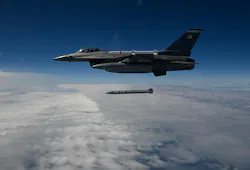
EGLIN AIR FORCE BASE, Fla. – U.S. Air Force guided weapons experts are asking Northrop Grumman Corp. to continue research and production of a precision air-to-ground missile for attacking relocatable high-value targets under terms of a $100 million contract announced Tuesday.
Officials of the Air Force Life Cycle Management Center at Eglin Air Force Base, Fla., are asking the Northrop Grumman Corp. Mission Systems segment in Northridge, Calif., for Stand-in Attack Weapon (SiAW) and Advanced Anti-Radiation Guided Missile-Extended Range (AARGM-ER).
SiAW attacks high-value relocatable targets in anti-access and area-denial (A2/AD) conditions like air-defense systems, missile launchers, GPS jammers, and anti-satellite systems. SiAW enables aircraft to penetrate enemy airspace for close engagements.
SiAW builds on the Navy's AGM-88G AARGM-ER, incorporating multi-mode guidance including anti-radiation homing, GPS/inertial navigation, millimeter-wave radar for moving targets, and a two-way data link for in-flight updates. It's designed to fit internally into the F-35 Lightning II's weapon bays.
Operational next year
SiAW carries a high-explosive warhead and offers ranges of about 96 to 120 miles. It's been fitted to the F-35 and F-16 combat jets, and should become operational sometime next year.
The AGM-88G AARGM-ER, meanwhile, is the newest version of the AGM-88 missile, and is compatible with U.S. and allied strike aircraft like the F/A-18 fighter bomber, EA-18G electronic warfare jet, F-16, and F-35.
It features an advanced digital anti-radiation homing sensor, millimeter wave radar terminal seeker, global positioning system (GPS) guidance, inertial navigation system guidance, net-centric connectivity, and weapon-impact-assessment (WIA) transmit.
The AGM-88G enables the U.S. and allied combat jets to attack and destroy enemy air-defense radar systems and time-critical mobile targets. It offers improved capabilities over the High-Speed Anti-Radiation Missile (HARM) systems it replaces, including advanced signal processing, improved frequency coverage, detection range, and field of view; time-critical, standoff strike; missile-impact zone control to prevent collateral damage; counter-emitter shutdown through active millimeter wave radar terminal guidance; and bomb damage assessment.
Internal weapons bays
The AGM-88G AARGM-ER uses the guidance system and warhead of the AGM-88E, and uses a solid integrated rocket-ramjet engine to double AGM-88E's range. It incorporates a redesigned control section and 11.5-inch diameter rocket motor for twice the range and internal carriage on the Lockheed Martin F-35A and F-35C Lightning II Joint Strike Fighter.
The AGM-88G, integrates the AGM-88E's warhead and guidance systems in a new airframe that replaces the mid-body wings with aerodynamic strakes along the sides with control surfaces relocated to low-drag tail surfaces and a more powerful propulsion system for greater speed and double the range of its predecessor. The AGM-88G weighs 1,030 pounds and is 13.3 feet long.
The AARGM-ER features new software and enhanced capabilities to counter radar shutdown and passive radar using an additional active millimeter wave seeker. Previous versions of the missile could be spoofed by turning off radar before the weapon could lock on to their signals.
On this contract Northrop Grumman will do the work in Northridge, Calif., and should be finished by December 2034. For more information contact Northrop Grumman Mission Systems online at www.northropgrumman.com/what-we-do/advanced-weapons/strike-missiles, or Naval Air Systems Command at www.navair.navy.mil.
