Lockheed Martin to provide gallium nitride (GaN)-based radar for Canadian surface warships
Key Highlights
Questions and answers:
- What company is building the radar for Canada's River-class destroyer, and what is the contract value? Lockheed Martin Corp. received a $104.6 million order to build an advanced gallium nitride (GaN)-based radar unit for the destroyer.
- What is the SPY-7 radar designed for, and what technology does it use? The SPY-7 is a solid-state S-band AESA radar for detection, tracking, and engagement of ballistic missiles, hypersonic threats, and aircraft, using GaN transmit and receive modules for improved cooling and upgradability.
- What does the Canadian River-class destroyer program aim to achieve? It modernizes Canada's navy by replacing aging Iroquois-class destroyers and Halifax-class frigates with 15 multi-role warships for air, surface, subsurface, and information warfare missions.
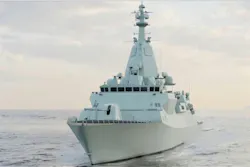
WASHINGTON – Lockheed Martin Corp. will build an advanced gallium nitride (GaN)-based radar for a future Canadian River-class destroyer under terms of a $104.6 million order announced last week.
Officials of the U.S. Naval Sea Systems Command are asking the Lockheed Martin Rotary and Mission Systems segment in Moorestown, N.J., for the Foreign Military Sale (FMS) portions unit of the Solid-State SPY AESA Radar (SPY-7) for the future Canadian River-class destroyer, which should join the Canadian fleet around 2035.
The SPY-7 modular shipboard radar enables Lockheed Martin to build different configurations for land- and sea-based applications. The radar also has been selected for the Spanish Bonifaz-class frigate and Japan's Aegis System Equipped Vessels (ASEV).
The SPY-7 solid-state S-band radar for surface warships uses GaN transmit and receive modules. Lockheed Martin initially developed the SPY-7 for the U.S. Navy’s Air and Missile Defense Radar (AMDR) competition.
Naval modernization
The Canadian River-class destroyer represents Canada's major naval modernization to replace aging Iroquois-class destroyers and Halifax-class frigates. This program aims to deliver 15 multi-role warships capable of air, surface, subsurface, and information warfare missions.
SPY-7 is a scalable radar that can provide ballistic missile defense, and provides several times the performance of traditional SPY-1 radars aboard U.S. Navy Burke-class destroyers and Ticonderoga-class cruisers.
SPY-7's GaN technology allows for improved cooling of the radar, which is made up of thousands of mini scanners, which make the radar easily upgradable as threats evolve.
Detection and tracking
The SPY-7 is for detection, tracking, and engagement of ballistic missiles, hypersonic threats, aircraft, and similar targets. It uses modular subarray suites for scalability across ship sizes or land bases to enable roles like integrated air and missile defense (IAMD), anti-air warfare (AAW), ballistic missile defense (BMD), and space domain awareness.
It offers polarization diversity to discriminate targets precisely and counter electronic warfare (EW). The radar also offers in-service maintenance and rapid software updates without hardware changes.
On this Foreign Military Sale order, Lockheed Martin will do the work in Moorestown, N.J., and should be finished by January 2032. For more information contact Lockheed Martin Rotary and Mission Systems online at www.lockheedmartin.com/en-us/products/spy-7.html, Naval Sea Systems Command at www.navsea.navy.mil, or the Royal Canadian Navy at www.canada.ca/en/department-national-defence/services/procurement/canadian-surface-combatant.html.
