Navy asks Boeing to upgrade F/A-18 E/F combat jet avionics, electronic warfare (EW), and radar
Key Highlights
Questions and answers:
- What is the purpose of the new $930.8 million U.S. Navy contract with Boeing? It aims to upgrade as many as 60 F/A-18E/F Super Hornets with Block III avionics and extend their service life from 6,000 to 10,000 flight hours.
- What key technologies are included in the Block III avionics upgrade? An AN/APG-79 AESA radar, infrared search and track (IRST) system, a 10-by-19-inch touchscreen display, and advanced networking for real-time data sharing and sensor fusion.
- When and where will Boeing complete the Super Hornet upgrades? Work will be done in San Diego, San Antonio, and St. Louis, with completion expected by November 2028.
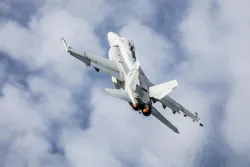
PATUXENT RIVER NAS, Md. – U.S. Navy combat aircraft experts are asking the Boeing Co. for avionics upgrades to as many as 60 F/A-18E/F Super Hornet carrier-based jet fighter-bombers under terms of a $930.8 million contract announced last Tuesday.
Officials of the Naval Air Systems Command at Patuxent River Naval Air Station, Md., are asking the Boeing Defense, Space & Security segment in St. Louis for integration of Block III avionics for Super Hornet aircraft.
The F/A-18E/F Super Hornet Block III features advanced avionics upgrades that enhance situational awareness, networking, and mission flexibility for the U.S. Navy's multirole strike fighter.
This contract includes service life modifications to extend the service life of for as many as 60 F/A-18 E/F Super Hornets from 6,000 flight hours to 10,000 flight hours.
AESA radar
The Block III Super Hornet avionics integrates an AN/APG-79 active electronically scanned array (AESA) radar for simultaneous air-to-air and air-to-ground operations with improved range and resolution. Super Hornet Block III avionics also include an infrared search and track (IRST) system -- often housed in a modified fuel tank -- for passive detection and targeting.
The cockpit features a large 10-by-19-inch touchscreen display that replaces several multi-function displays, as well as updated processors and an industry-standard open-systems architecture.
Super Hornet upgraded Block III networking and sensors enable sensor fusion among several aircraft, real-time data sharing via tactical targeting network technology, and rapid weapons cueing.
EW and ISR
These capabilities support network-centric warfare; intelligence, surveillance, and reconnaissance; electronic warfare (EW), and network integration with other aircraft like the EA-18G Growler EW jet.
The Block III Super Hornet avionics also incorporate reduced-radar-cross-section features and Joint Helmet Mounted Cueing System (JHMCS) compatibility.
On this contract, Boeing will do the work in San Diego; San Antonio; and St. Louis, and should be finished by November 2028. For more information contact Boeing Defense, Space & Security online at www.boeing.com/defense/fighters-and-bombers/fa-18-super-hornet-and-ea-18-growler, or Naval Air Systems Command at www.navair.navy.mil.
