RTX Raytheon to build command and control and radar for Patriot missile air-defense batteries
Key Highlights
Questions and answers:
- What company received the contract for the Patriot missile firing unit? RTX Corp.'s Raytheon segment in Andover, Mass.
- What is the value and timeline of the U.S. Army contract announced? $168.1 million order, with work to finish by September 2029.
- What does a standard Patriot battery include? Phased array radar (like AN/MPQ-53 or AN/MPQ-65), engagement control station, power-generation units, antenna masts, and up to eight launch stations.
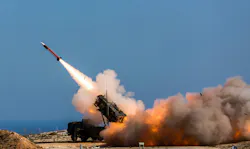
REDSTONE ARSENAL, Ala. – Missile-defense experts at RTX Corp. will build and integrate radar, command systems, launchers, and support equipment to enable the Patriot missile to detect, track, and intercept threats like aircraft, cruise missiles, and ballistic missiles.
Officials of the U.S. Army Contracting Command at Redstone Arsenal, Ala., announced a $168.1 order in late December to the RTX Raytheon segment in Andover, Mass., for a Patriot firing unit.
Patriot, which is an acronym for Phased Array Tracking Radar to Intercept on Target, is a hit-to-kill missile designed to defeat tactical ballistic missiles, cruise missiles, and aircraft. It is a high- to medium-altitude long-range air defense missile that defends ground combat forces and high-value military equipment.
High-velocity interceptor
The MIM-104 Patriot Advanced Capability-3 (PAC-3) missile is a high velocity interceptor that defeats incoming targets by body-to-body direct impact. PAC-3 missiles, when deployed in a Patriot battery, provide 16 PAC-3s on a Patriot launcher.
The Patriot missile firing unit, known as a Patriot battery or fire unit, is the basic component of the Patriot missile. It integrates radar, command systems, launchers, and support equipment to detect, track, and intercept threats like aircraft, cruise missiles, and ballistic missiles.
A standard Patriot battery consists of a phased array radar like the AN/MPQ-53 or AN/MPQ-65 for surveillance and tracking; an engagement control station for command and control; power-generation units; antenna masts; and as many as eight launch stations.
Patriot variants
The M901, M902, and M903 launch stations carry missiles such as Patriot PAC-2 or PAC-3 variants, with capacities ranging from four to sixteen per launcher depending on the model.
The system uses radar to detect, target, and classify incoming missiles, selects the most effective launchers, and fires missiles in a ripple sequence to intercept using hit-to-kill or blast-fragmentation, based on missile type.
On this order, RTX Raytheon will do the work in Andover, Mass., and should be finished by September 2029. For more information contact RTX Raytheon online at www.rtx.com/news/2025/05/29/patriot-proven-in-battle-and-still-setting-standards, or the Army Contracting Command-Redstone at https://acc.army.mil/contractingcenters/acc-rsa/.
