Army looking for multispectral smoke screen to hide warfighters from enemy electro-optical sensors
Key Highlights
Summary points:
- U.S. Army is inviting industry input on a portable system that can conceal troops and vehicles from enemy sensors across visual to millimeter-wave spectra.
- Proposed system should deploy within 95 seconds to obscure a 204-meter area for as long as 12 minutes without resupply.
- Companies can submit five-page proposals to Army officials at Aberdeen Proving Ground for the Screening Obscuration Module (SOM) Multispectral program.
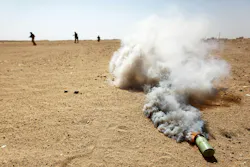
EDGEWOOD, Md. – U.S. Army battlefield obscurant experts are surveying industry for companies able to create a smoke screen on the battlefield that can hide infantry and combat vehicles from enemy electro-optical sensors that range from the visual through millimeter wave portion of the electromagnetic spectrum.
Officials of the Army Contracting Command-Aberdeen Proving Ground Edgewood Contracting Division in Edgewood, Md., have issued a request for information (W911SR-26-R-SOMB) for the Screening Obscuration Module (SOM) Multispectral program.
The Army wants to hear from companies able to provide a multispectral smoke screen from a soldier-carried system small enough for one infantryman to carry and place on the ground to produce a smoke screen that hides infantry and military vehicles from the visual through millimeter wave.
This system should be able to hide infantry and vehicles from enemy electro-optical sensors operating in the ultraviolet, visible light, and near-infrared spectra from 0.04 to 1.2 microns; from sensors operating in the midwave infrared spectrum from 3 to 5 microns; from sensors operating in the infrared spectrum from 8 to 12 microns; and even from microwave radar operating in the 1-to-10 millimeter wavelength region.
95-second deployment
This smoke screen should be able to hide warfighters and vehicles from enemy electro-optical sensors and microwave radar in an area 204 meters long and from ground level to 40 feet high within 95 seconds for a duration of 12 minutes without resupply.
Army researchers are asking industry to provide an existing commercial system, a modified system, or rapidly develop a system and obscurant materials. A government-furnished technical data package is available on request. The SOM Multispectral project will last for two to four years.
If a company is interested in accessing the government-furnished technical data package, email five-page requests to the Army's Emily McGill at [email protected] and Marc Lukaszewicz at [email protected].
Companies interested should email five-page responses no later than 31 March 2026 to the Army's Emily McGill at [email protected] and Marc Lukaszewicz at [email protected]. More information is online at https://sam.gov/workspace/contract/opp/dba81310491d4855be89e41ef3c6cf1a/view.
