Navy asks L3Harris for submarine-based long-range towed-array sonar to detect quiet enemy submarines
Key Highlights
Questions and answers:
- What is the value of the contract awarded to L3Harris Technologies for the TB-29C sonar? The U.S. Navy awarded a $30.9 million contract to L3Harris Maritime division in Millersville, Md., to produce the TB-29C towed-array sonar.
- What are the key features of the TB-29C towed-array sonar? The TB-29C is a next-generation thin-line towed-array passive sonar with 416 channels, the same form factor as the TB-29A, improved reliability, and equivalent acoustic performance to detect quiet enemy submarines at long ranges.
- What is the purpose of towed-array sonar on Virginia-class submarines? Towed-array sonar uses hydrophones on a trailing cable to keep sensors away from vessel noise, improving detection and tracking of faint contacts like quiet nuclear- and diesel-powered submarines in open ocean and littoral waters.
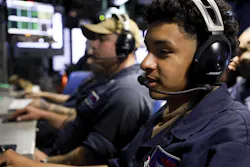
WASHINGTON – U.S. Navy submarine sonar experts needed a thin-line towed-array sonar to help the Virginia-class fast-attack submarine detect quiet enemy submarines at long ranges. They found a solution from L3Harris Technologies Inc.
Officials of the Naval Sea Systems Command in Washington announced a $30.9 million contract Thursday to the L3Harris Maritime division in Millersville, Md., to produce the TB-29C towed-array sonar.
TB-29C is the Navy’s next-generation thin line long-range towed array passive sonar that has the same form factor to the TB-29A with improved reliability.
This next-generation TB-29C towed-array sonar will help Virginia-class attack submarines detect, track, and classify quiet, modern submarine threats in open ocean and littoral waters.
416 channels
The TB-29C is a 416 channel thin line towed array with an equivalent acoustic performance capability to TB-29A. The TB-29C thin-line towed-array sonar receiver that has the same form factor as the TB-29 array, yet offers increased capability, greater reliability and reduced obsolescence.
Sonar designers at L3Harris and the Lockheed Martin Rotary and Mission Systems segment in Liverpool, N.Y. build versions of the TB-29 towed-array sonar.
Towed-array sonar uses hydrophones towed on a cable trailing behind a submarine or a surface ship; it can be miles long. It's designed to keep the array's sensors away from tow vessel noise to improve its signal-to-noise ratio and its ability to detect and track faint contacts like quiet nuclear- and diesel-powered submarines and seismic signals.
Complex designs
Effective use of towed-array sonar systems limit a vessel's speed, and crews must take care to protect the cable from damage. Current towed-array systems also are complex designs and need to be upgraded to maintain reliability while deployed, while stowed, and while reeling the array in and out of submarines and other marine vessels.
L3Harris and Lockheed Martin also build the TB-29A Compact Towed Array (CTA) towed-array sonar. The TB-29A CTA offers significant reduction in sensor power, internal component diameter, bend radius, and production costs.
The TB-29A CTA submarine thin-line array is designed to reduce complexity, lower power, and improve robustness to withstand in-situ operations and stresses of handling systems, Navy officials say.
Multi-mission commonality
Its performance telemetry, acoustic sensors, and electronics are designed to provide a ubiquitous solution across the spectrum of submarine, surveillance, and unmanned towed arrays. This multi-mission commonality for these high-volume and unique components provides cost savings from procurement to life cycle support.
The TB-29A CTA provides the Navy with major technical advancements in towed array capabilities, Navy officials say. It can be used aboard attack, cruise-missile, and ballistic-missile submarines, as well as on unmanned surface vessels.
On this contract L3Harris will do the work in Millersville, Md.; Liverpool, N.Y.; and Ashaway, R.I., and should be finished by September 2028. For more information contact L3Harris Maritime online at www.l3harris.com/all-capabilities/maritime-solutions, or Naval Sea Systems Command at www.navsea.navy.mil.
