Lockheed Martin to build three air-defense radar systems for combat zones at the battlefield edge
Key Highlights
Questions and answers:
- What contract was recently awarded to Lockheed Martin for U.S. Air Force radar systems? The Air Force awarded Lockheed Martin a $68.5 million contract to build three AN/TPY-4 Three-Dimensional Expeditionary Long-Range Radar (3DELRR) systems.
- What is the purpose of the 3DELRR radar system? The 3DELRR is designed to detect, identify, and track enemy missiles, aircraft, and UAVs, providing real-time data for air defense and air traffic control operations.
- How does the 3DELRR compare to existing radar systems? The 3DELRR replaces the older AN/TPS-75 radar, offering longer-range detection using advanced gallium nitride (GaN) technology and interoperability with allied systems.
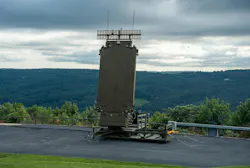
HANSCOM AIR FORCE BASE, Mass. – U.S. Air Force tactical radar experts are asking Lockheed Martin Corp. to build three air-defense radar systems to detect, identify and track enemy missiles as well as manned and unmanned aircraft.
Officials of the Air Force Life Cycle Management Center at Hanscom Air Force Base, Mass., announced a $68.5 million order to the Lockheed Martin Corp. Rotary and Mission Systems segment in Liverpool, N.Y., for three AN/TPY-4 Three-Dimensional Expeditionary Long-Range Radar (3DELRR) systems.
The 3DELRR radar is to replace the Air Force's Northrop Grumman AN/TPS-75 transportable 3-D passive electronically scanned array air-defense radar for enabling U.S. and allied invasion forces to protect themselves from airborne threats after establishing beachheads. This contract modification brings the total face value of Lockheed Martin's 3DELRR contract to $554.1 million.
The 3DELRR system is designed to deal with regional and near-peer conflicts of the future that could involve large numbers of enemy advanced unmanned aerial vehicles (UAVs), fixed-wing aircraft, helicopters, and ballistic and cruise missiles.
Radar interoperability
The 3DELRR transportable air-search radar system is designed to detect, identify, and track objects at great distances in combat zones at the edge of the battlefield. The radar is interoperable with coalition systems and meet the requirements of many foreign militaries.
The 3DELRR system is similar to the Ground/Air Task-Oriented Radar (G/ATOR) that Northrop Grumman is building the for U.S. Marine Corps. G/ATOR is being developed to protect Marine Corps expeditionary forces from rockets, artillery, mortars, cruise missiles, UAVs, and other low observables. It is a deployable short-to-medium-range multi-role radar system. 3DELRR, on the other hand, is designed to detect and track threats at longer ranges.
Like 3DELRR, the G/ATOR is based on gallium nitride (GaN) technology, yet the G/ATOR system is designed to handle air surveillance, weapon cueing, counter-fire target acquisition, and air traffic control for Marine Corps warfighters operating in invasion beaches.
Targeting information
The 3DELRR will provide the Air Force control and reporting center with real-time data to display air activity, and will provide warning and target information.
The system also will provide operators with a precise, real-time air picture to provide air traffic control services to individual aircraft across a wide range of environmental and operational conditions.
On this order Lockheed Martin will do the work in Liverpool, N.Y., and should be finished by March 2027. For more information contact Lockheed Martin Rotary and Mission Systems online at www.lockheedmartin.com/en-us/products/ground-based-air-surveillance-radars/tpy-4.html, or the Air Force Life Cycle Management Center at www.aflcmc.af.mil.
