Navy asks RTX Raytheon to upgrade navigation, communications, and jam hardening of Tomahawk missile
Key Highlights
Questions and answers:
- What is the value of the U.S. Navy's order to RTX Corp. for Tomahawk missile upgrades? The order is worth $380.8 million for recertification and modernization of Tomahawk lots five and six.
- What key upgrade does Tomahawk Block V provide over Block IV? It adds 15 years to the missile's service life, with improvements in navigation, communications, and electronic warfare resistance.
- What capabilities does the Tomahawk Block IV missile feature? It includes a two-way satellite data link for in-flight retargeting, loiter capability, and an electro-optical sensor for battle damage assessment.
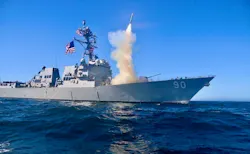
PATUXENT RIVER NAS, Md. – U.S. Navy guided missile experts are asking RTX Corp. to upgrade and recertify versions of the BGM-109 Tomahawk land-attack missile to add 15 years of service to the weapon's lifetime.
Officials of the Naval Air Systems Command at Patuxent River Naval Air Station, Md., announced a $380.8 million order Wednesday to the RTX Raytheon segment in Tucson, Ariz., for recertification and modernization of Tomahawk lots five and six. Each lot of Tomahawk missiles represents about 90 weapons. This process will upgrade Tomahawk Block IV to Tomahawk Block V cruise missiles.
Tomahawk Block IV, also known as Tactical Tomahawk or TLAM-E, entered service in 2004 and features a two-way satellite data link for in-flight retargeting to pre-programmed or GPS coordinates, loiter capability for hours, and an electro-optical sensor for real-time battle damage assessment via satellite imagery.
15-year life extension
Tomahawk Block V, meanwhile upgrades and recertifies Tomahawk Block IV missiles to add 15 years to their lifetimes, and offers upgraded navigation, communications, improved electronic hardening against electronic warfare (EW) jamming, and improves survivability.
Variants of Tomahawk Block V include a maritime-strike munition with anti-ship seeker for moving sea targets, and one with a multi-effects warhead for land targets. The Tomahawk Block IV missile is for land-attack; the missile launches from surface U.S. and United Kingdom warships and submarines. Its users are the U.S. Navy and the United Kingdom Royal Navy.
This upgrade replaces life-limited components at their mid-life point at Raytheon facilities in Tucson, Ariz., or Camden, Ark. Recertification replaces aging parts like those from late-1990s and early-2000s to ensure reliability.
Upgraded components
During disassembly, RTX technicians upgrade the missile's navigation and communications, data-link radios, and extended-range satellite communications.
The Tomahawk Block IV combines inertial navigation; Global Positioning System (GPS) satellite navigation; terrain contour matching; and digital scene matching area correlation. Its GPS and gyro-based inertial navigation helps keep the missile on target from long ranges, and its terrain- and scene-matching capabilities use optical sensors to view the ground below to ensure the weapon is on the right path.
On this contract modification, Raytheon will do the work in Tucson and Chandler, Ariz.; Boulder, Colo.; Pontiac, Mich.; Lincoln, Neb.; Clearwater, Fla.; Irvine, Ontario, and Los Alamitos, Calif.; East Camden and Huntsville, Ark.; Keyser, W.Va.; ; Midland, Ontario; and other locations, and should be finished by April 2029. For more information contact RTX Raytheon online at www.rtx.com/raytheon/what-we-do/sea/tomahawk-cruise-missile, or Naval Air Systems Command at www.navair.navy.mil.
