Army eyes wearable electronics to help working military dogs with surveillance and reconnaissance
Key Highlights
Questions and answers:
- What is the purpose of the Scalable, Modular Canine Intelligence, Surveillance and Reconnaissance System (SM-CISRS)? It is designed to equip military working dogs with modular, dog-worn electronics to improve their intelligence, surveillance, and reconnaissance missions.
- What kinds of technologies can be integrated into the SM-CISRS equipment worn by Army dogs? The system can include GPS collars or vests, onboard cameras, multi-spectral electro-optical sensors, environmental and health sensors, and communication radios.
- How does AI-driven software support the dogs and their handlers in SM-CISRS missions? AI software can analyze canine behavior and fuse GPS, terrain, and weather data to predict likely victim or target locations and coordinate with uncrewed aircraft.
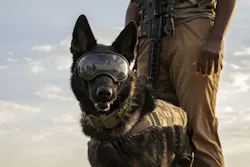
ABERDEEN PROVING GROUND, Md. – U.S. Army canine specialists needed a variety of dog-worn electronics to help military working dogs participate in surveillance and reconnaissance missions. They found a solution from Mantel Technologies Inc. in Fort Collins, Colo.
Officials of the Army Contracting Command Adelphi Division at Aberdeen Proving Ground, Md., announced a $49,.9 million contract to Mantel last week for the Scalable, Modular Canine Intelligence, Surveillance and Reconnaissance System (SM-CISRS).
This system seeks to integrate artificial intelligence (AI)-driven reconnaissance, modular sensors, and scalable equipment to boost canine intelligence, surveillance, and reconnaissance (ISR) missions for working military dogs.
Mantel Technologies has core expertise in canine systems like medical and performance enhancements for working military dogs, wearable electronics and neuromodulation for human warfighters, advanced materials and thermal management, and systems interoperability that involves AI and machine learning.
Real-time surveillance
SM-CISRS equips Army dogs with lightweight, interchangeable modules for real-time surveillance, threat detection, and data relay to enhance autonomy and reduce the workload of dog handlers. It builds on prior canine-uncrewed aircraft teams and robot dog technology for persistent ISR in contested areas.
The project seeks to equip military working dogs with modular electronics to enhance ISR capabilities using lightweight, rugged wearables such as GPS collars or vests for real-time location tracking and data fusion with environmental sensors.
Onboard cameras can stream live video feeds, while inertial navigation units, Doppler radar, and barometric altimeters can enable precise positioning in GPS-denied areas like buildings or tunnels.
Communications radios
Communication radios support ranges as far as 980 feet in confined spaces to enable dog handlers to receive telemetry via tablet computers or small uncrewed aircraft.
Multi-spectral electro-optical sensors and low-profile antennas can enable day and nighttime surveillance, tagging and tracking, and signals intelligence (SIGINT) integration using modular payloads for dogs.
AI-driven software, such as behavior analysis algorithms can fuse canine GPS data with topography and weather for predictive victim and target location for scalable teaming with uncrewed aircraft. Directional buzzers or haptic feedback in vests can enable remote command guidance to dogs without verbal cues.
Dog-wearable batteries
Dog-wearable batteries can offer four hours or more of continuous video, lights, and communications, with health sensors monitor canine vitals like heart rate in harsh conditions.
Modular designs can support open-systems architectures for rapid payload switchouts, low size, weight, power consumption, and interoperability with special forces networks.
On this contract, Mantel Technologies will do the work at locations to be determined with each order, and should be finished by January 2031. For more information contact Mantel Technologies online at https://manteltechnologies.com/, or the Army Contracting Command Adelphi Division at https://acc.army.mil/contractingcenters/acc-apg/.
