Navy asks L3Harris to build fat-line towed-array passive sonar systems for fast attack submarines
Key Highlights
Questions and answers:
- What is the value of the contract awarded to L3Harris for the TB-34A sonar systems? The contract is worth $22.9 million.
- What does the TB-34A sonar system replace on U.S. Navy submarines? It replaces the legacy TB-16 towed array on Los Angeles-, Seawolf-, and Virginia-class attack submarines.
- How does the TB-34A differ from the TB-29 in design and purpose? The TB-34A is a shorter (75 meters), thicker (7.5 cm diameter) fat-line array for tactical use in shallow coastal waters, while the TB-29 is a longer (825 meters), thinner (3.8 cm diameter) array for long-range detection at high speeds.
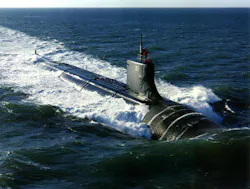
WASHINGTON – Sonar experts at L3Harris Technologies Inc. will build and test TB-34A fat-line towed-array sonar systems for U.S. Navy fast attack submarines under terms of a $22.9 million contract announced Monday.
Officials of the Naval Sea Systems Command in Washington are asking the L3Harris Maritime division in Millersville, Md., for TB-34A towed array production, integration, and testing.
The L3Harris TB-34A is a fat-line towed array sonar system designed to replace the legacy TB-16 array aboard U.S. Navy Los Angeles-, Seawolf, and Virginia-class attack submarines.
The TB-34A enhances passive sonar processing with additional hydrophones for improved anti-submarine warfare (ASW) and contact avoidance in shallow coastal waters.
Passive sonar
The TB-34A is a passive acoustic sensor that trails behind submarines via a tow cable to provide data to the Acoustic Rapid Commercial-off-the-Shelf Insertion (A-RCI) on-board computers for processing and operator displays.
The sonar integrates with other sensors like spherical, hull-mounted, wide-aperture array, and high-frequency sonar arrays to support missions search, detection, tracking, and intelligence gathering.
Compared to the TB-16 towed array, the TB-34A offers better towing stability, reduced self-noise, and more hydrophones for future processing upgrades. TB-34A electronic modules are interchangeable with fielded units to ensure compatibility with TB-34A tow cables, array modules, handling systems, and the AN/BQQ-10 host sonar system.
This is the second contract to L3Harris this month for Navy submarine towed-array sonar systems. On 15 Jan. the company won a $30.9 million contract for the TB-29C towed-array sonar -- the Navy’s next-generation thin line long-range towed array passive sonar.
Fat-line array
The TB-29 and TB-34 both are passive submarine towed-array sonar systems, but they differ in design, deployment, and operational roles. While the TB-34 is a fat-line tactical array that is 75 meters long with 7.5-centimeter diameter, while the TB-29 is a thin-line array about 825 meters long with a 3.8 centimeter diameter.
The TB-34 is optimized for hunting enemy submarines and avoiding obstacles in shallow coastal waters at low speeds, while the TB-29 is optimized for very-low-frequency (VLF) long-range detection at relatively high towing speeds.
The TB-34 targets surface vessels, submarines in cluttered coastal environments, and provides situational awareness for missions like strike warfare or surveillance and reconnaissance. The TB-29, meanwhile, excels at detecting distant open-ocean threats and modern quiet submarines.
On this contract L3Harris will do the work in Millersville, Md.; Liverpool, N.Y.; and Ashaway, R.I., and should be finished by July 2028. For more information contact L3Harris Maritime online at www.l3harris.com/all-capabilities/maritime-solutions, or Naval Sea Systems Command at www.navsea.navy.mil.
