Army orders radio-controlled anti-tank missiles from RTX Raytheon for U.S. and allied infantry
Key Highlights
Questions and answers:
- What is the TOW 2B missile order about? RTX Corp. received a $193.7 million U.S. Army order to build Tube-Launched, Optically Tracked, Wireless-Guided (TOW) 2B anti-tank missiles.
- How does the TOW 2B missile work? The operator keeps sight crosshairs on the target using an optical sight; a wireless RF link from the launcher automatically steers the missile along the line-of-sight to the aim point.
- What military systems use TOW missiles? TOW missiles fire from Improved Target Acquisition Systems (ITAS), Stryker vehicles, Bradley Fighting Vehicles, Humvees, ground fortifications, Light Armored Vehicles, and AH-1W Cobra helicopters.
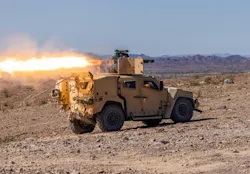
REDSTONE ARSENAL, Ala. – RTX Corp. will build radio-controlled anti-tank missile systems for the U.S. Army under terms of a $193.7 million order announced on Tuesday.
Officials of the U.S. Army Contracting Command at Redstone Arsenal, Ala., are asking the RTX Raytheon segment in Tucson, Ariz., to build the Tube-Launched, Optically Tracked, Wireless-Guided (TOW) 2B munition -- better-known as the TOW 2B missile.
The multimission TOW 2A, TOW 2B, TOW 2B aero, and TOW bunker-buster missiles are a primary precision anti-armor, anti-fortification, and anti-amphibious landing weapons used throughout the world today, RTX officials say.
The TOW 2B anti-tank missile operator defines the aim point by maintaining the sight cross hairs on the target. The launcher automatically steers the missile along the line-of-sight toward the aim point via a one-way RF and microwave link, which links the launcher and missile for guidance.
Optical missile sight
The operator uses an optical missile sight attached to the launcher; the sight is data linked to the missile. Wireless TOW missiles include an RF transmitter added to the missile case and an RF receiver located inside the missile.
When the optically guided missile fires, the RF transmitter in the launcher relays information to the missile while in flight. The operator keeps the sight fixed on the target -- even if the target is moving -- to guide the missile to its target. Original versions of the TOW, which were called the tube-launched, optically-tracked, wire-guided missile, trailed a thin wire that relayed information to the missile from the sight.
TOW missiles can be fired from all TOW launchers, including the Improved Target Acquisition Systems (ITAS), Stryker anti-tank guided missile vehicle (modified ITAS), and Bradley Fighting Vehicles (Improved Bradley Acquisition Subsystem).
TOW launchers can be mounted to a wide variety of vehicles, including the Humvee, and also can be placed in improvised ground fortifications for front-line infantry use. Versions of the TOW missile also can be fired from Light Armored Vehicle–Anti-tank and U.S. Marine Corps AH-1W Cobra attack helicopter.
Decades-long use
If the TOW weapon system remains in service with the U.S. military beyond 2050 as military officials plan today, it will have remained in the Pentagon's arsenal for more than 80 years.
TOW is in service in more than 40 international armed forces and integrated on more than 15,000 ground versions, vehicle- and helicopter-mounted versions worldwide, RTX officials say.
On this order RTX will do the work in Tucson, Ariz., and should be finished by September 2028. For more information contact RTX Raytheon online at www.rtx.com/raytheon/what-we-do/land/tow-weapon-system, or the Army Contracting Command-Redstone at https://acc.army.mil/contractingcenters/acc-rsa/.
