Navy asks Ultra Maritime for MK3 and MK4 torpedo defense countermeasures that involve acoustic jamming
Key Highlights
Questions and answers:
- What company received the $59.6 million contract from the Naval Sea Systems Command? Ultra Maritime in Braintree, Mass.
- How does the MK3 torpedo decoy work? It emits programmed acoustic noise, jamming, or decoy sounds underwater to confuse and mislead incoming torpedoes away from the submarine.
- What is the primary function of the MK4 countermeasure? It acts as an expendable sonar jammer that defeats advanced torpedoes by repeatedly restarting their target verification process.
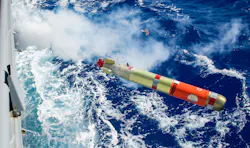
WASHINGTON – U.S. Navy undersea warfare experts needed torpedo-defense decoys for deployed submarines. They found a solution from Ultra Maritime in Braintree, Mass.
Officials of the Naval Sea Systems Command announced a $59.6 million contract to Ultra Maritime on Tuesday for MK3 and MK4 acoustic device countermeasures for in-service submarines.
The MK3 refers to the 6-inch ADC Mk 3 Mod 1 expendable acoustic torpedo decoy for submarines for soft-kill torpedo defense -- meaning it emits underwater signals that spoofs incoming torpedoes into missing the submarine.
The MK3 confuses incoming torpedoes rather than destroying them. I's typically stowed between the host submarine's pressure hull and outer hull in special launch containers. It shoots into the water via a gas generator.
Programmed acoustic jamming
Once in the water, the countermeasure activates and produces programmed acoustic noise, jamming, or other decoy-like sounds to mislead a torpedo’s homing logic and draw it away from the submarine. The MK3 is part of a layered torpedo defense that involves other torpedo countermeasures.
The MK4, meanwhile, is an expendable sonar jammer to defend submarines from incoming torpedoes. It's primarily a jammer rather than a decoy, It defeats advanced torpedoes by restarting the torpedo's target verification repeatedly.
On this contract, Ultra Maritime will do the work in Braintree, Mass., and should be finished by January 2031. For more information contact Ultra Maritime online at https://umaritime.com/, or Naval Sea Systems Command at www.navsea.navy.mil.