BAE Systems to upgrade APKWS air-to-air rockets to take-on swarms of enemy small uncrewed aircraft
Key Highlights
Questions and answers:
- What is the purpose of the Air Force’s Air-to-Air Dual Mode project? To upgrade the AGR-20F Advanced Precision Kill Weapon System (APKWS) with a longwave infrared seeker and proximity fuze to counter swarms of as many as 200 small medium-range uncrewed aircraft.
- What upgrades is BAE Systems Electronic Systems making to the APKWS rocket? The company is adding a nose-mounted longwave infrared seeker, a mid-body warhead with dual safe proximity fuze, and modified guidance sections, while keeping the rocket’s outer mold line largely unchanged for compatibility and cost effectiveness.
- How will the upgraded APKWS be deployed and who is managing the effort? The upgraded 2.75-inch rocket will deploy from helicopters and fixed-wing aircraft, and is being managed by the Air Force Life Cycle Management Center at Eglin Air Force Base, with prototype assembly at Hill Air Force Base, Utah.
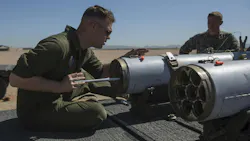
EGLIN AIR FORCE BASE, Fla. – U.S. Air Force air-defense experts needed an air-to-air weapon to counter swarms of enemy small medium-range uncrewed aircraft. They found a solution from the BAE Systems Electronics Systems segment in Nashua, N.H.
Officials of the Air Force Life Cycle Management Center at Eglin Air Force Base, Fla., announced a potential $145 million five-year sole-source contract to BAE Systems on 12 Feb. 2026 for Air to Air Dual Mode project to fit infrared seekers to existing air-to-air rockets.
This Joint Urgent Operational Need (JUON) contract calls for BAE Systems to upgrade the company's AGR-20F Advanced Precision Kill Weapon System (APKWS) laser-guided rocket by adding a longwave infrared seeker, mid-body warhead with dual safe proximity fuze, and modified guidance sections to attack swarms of as many as 200 enemy small uncrewed aircraft.
The prototype 2.75-inch rocket is to deploy from helicopters and fixed-wing aircraft -- particularly the Air Force F-16 jet fighter -- to provide a flexible and adaptable counter-uncrewed-aircraft system for different counter-uncrewed scenarios.
Upgrading APKWS rocket
Upgrades to the BAE Systems APKWS rockets include a new nose mounted longwave infrared seeker and mid-body warhead with dual safe proximity fuze to ensure minimal changes to the rocket's existing outer mold line.
These upgrades will enable the rocket to hand-off targeting information from its laser designator quickly to the new longwave infrared seeker to minimize time aircraft pilots must keep the laser on the target.
New subcomponents are to be interchangeable with the existing APKWS interface developed by BAE Systems to increase capabilities and ensure cost effectiveness, Air Force officials say.
This urgent-need project began in 2024 to upgrade APKWS technology with a new infrared seeker, warhead, dual safe proximity fuze, and guidance sections to deter and attack evolving adversary small uncrewed aircraft.
Longwave infrared seeker
This effort primarily calls for BAE Systems to develop the longwave infrared seeker, mid-body warhead with dual safe proximity fuze and modified guidance sections. Government personnel at Hill Air Force Base, Utah, will assemble 300 prototype counter-uncrewed munitions to defend against swarms of small medium-range uncrewed aircraft.
The goal of the project is to capitalize on the success of the BAE Systems APKWS as a cost-effective counter-uncrewed solution with reduced lase time to enable rates of fire.
The company's APKWS currently is the most cost-effective munition that meets the required capabilities with minimal changes, and can be integrated quickly onto the F-16 jet fighter, Air Force experts say.
On this contract, BAE Systems will do the work in Hudson, N.H., and should be finished by February 2031. BAE Systems will finish the contract's first delivery order by July 2027. For more information contact BAE Systems Electronic Systems online at www.baesystems.com/en-us/who-we-are/electronic-systems, or the Air Force Life Cycle Management Center at www.aflcmc.af.mil.
