Lockheed Martin to maintain anti-submarine warfare (ASW) and counter-mine system for undersea warfare
Key Highlights
Questions and answers:
- Which company received the $78.4 million contract to upgrade and maintain the AN/SQQ-89A(V)15 systems? Lockheed Martin Corp. Rotary and Mission Systems segment in Manassas, Va.
- Which countries’ navies, besides the U.S., operate the AN/SQQ-89A(V)15 on their surface warships? Japan and Australia.
- What types of threats does the AN/SQQ-89A(V)15 system detect and track? Submarines, mines (floating, tethered, or bottom-attached), and torpedoes.
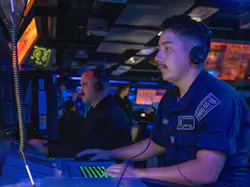
WASHINGTON – Undersea warfare experts at the Lockheed Martin Corp. Rotary and Mission Systems segment in Manassas, Va., will upgrade and maintain U.S. Navy AN/SQQ-89A(V)15 anti-submarine warfare (ASW) systems for surface warships under terms of a $78.4 million order contract announced Friday.
Officials of the Naval Sea Systems Command in Washington are asking Lockheed Martin to maintain fielded AN/SQQ-89A(V)15 Surface Ship Undersea Warfare Combat System baselines and perform integration and certification of future baselines.
This contract also involves foreign military sales to maintain and upgrade AN/SQQ-89A(V)15 surface warship ASW systems for Japan and Australia. The AN/SQQ-89A(V)15 is aboard the Japanese destroyers JS Atago, JS Ashigara, JS Maya, and JS Haguro. The Australian Hobart-class destroyers HMAS Hobart, HMAS Brisbane, and HMAS Sydney also have the system.
The AN/SQQ-89A(V)15 is an undersea combat system for surface warships is designed to search for, detect, classify, localize, and track underwater contacts; and to attack or avoid enemy submarines, floating, tethered, or bottom-attached mines, and torpedoes.
Active and passive sonar
The AN/SQQ-89A(V)15 uses active and passive sonar to enable Navy Arleigh Burke-class destroyers and Ticonderoga-class cruisers to detect, locate, track, and attack hostile submarines, mines, and torpedoes.
The counter-mine and anti-torpedo system provides multi-sensor track correlation and target track management control, and forwards data to the ship’s weapons and decision-support systems. The AN/SQQ-89A(V)15 works together with the ship's active and passive hull sonar, multi-function towed array, sonobuoy processing, torpedo alerts, fire-control system, sensor performance predictions, embedded operator, and team training systems.
The AN/SQQ-89A(V)15 has an open electronics architecture to accommodate system upgrades, and makes the most of data accessibility and system modules, Lockheed Martin officials say. Its software application programs are isolated from hardware with open middleware to render applications processor-independent.
Open-systems software
The system uses POSIX-compliant system calls and Motif and X-compliant display service calls. Symmetric multi-processors (SMPs) using Linux-based processing handle signal, data, display, and interface processing.
Virtual Network Computing (VNC) enables rapid re-allocation of operator console displays to suit the tactical situation, Lockheed Martin officials say.
Recent and planned upgrades to the AN/SQQ-89A(V)15 include improved automated torpedo detection, sonar performance prediction, advanced active sonar processing, re-designed active displays to reduce operator loading, and integrated training and logistics.
Integrated systems
The AN/SQQ-89 is integrated with the Aegis combat system, vertical launch anti-submarine rocket (ASROC) system. A variant of the AN/SQQ-89A(V)15 is integrated with late-version Aegis combat systems being installed onboard new Arleigh Burke-class destroyers. A back-fit program is in place to retrofit existing DDG-51 class ships and Ticonderoga-class cruisers.
On this contract, Lockheed Martin will do the work in Manassas, Fairfax, and Reston, Va.; Uniontown, Pa.; and San Diego, and should be finished by February 2027. With options, work could continue through February 2031.
For more information contact Lockheed Martin Rotary and Mission Systems online at www.lockheedmartin.com/en-us/who-we-are/business-areas/rotary-and-mission-systems.html, or Naval Sea Systems Command at www.navsea.navy.mil.
