Air Force asks Boeing for more inertial and satellite-guided Massive Ordnance Penetrator super-bombs
Key Highlights
Questions and answers:
- What is the U.S. Air Force buying under the new $61.5 million contract? The Air Force is asking Boeing to replenish its supply of GBU-57 Massive Ordnance Penetrator (MOP) 30,000-pound bunker-busting bombs, along with related tail kits, fuzing components, and support hardware.
- What is the GBU-57 Massive Ordnance Penetrator designed to do? It is built to destroy hardened and deeply buried targets, penetrating up to 200 feet of earth or more than 26 feet of reinforced concrete before detonating its 6,000-pound high-explosive warhead.
- Which aircraft carry the Massive Ordnance Penetrator? The MOP is carried by U.S. Air Force B-2 Spirit stealth bombers and B-52 heavy bombers for high-altitude release against fortified targets.
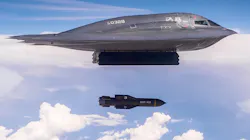
EGLIN AIR FORCE BASE, Fla. – The U.S. Air Force is asking the Boeing Co. to replenish the nation's supply of GBU-57 Massive Ordnance Penetrator bunker-busting super bombs under terms of a $61.5 million sole-source contract announced last week.
Officials of the Air Force The Armament Directorate’s Attack Division at Eglin Air Force Base, Fla., are asking the Boeing Defense, Space & Security segment in St. Louis for the replenishment of GBU-57 Massive Ordnance Penetrator weapon systems.
The satellite-guided Massive Ordnance Penetrator, otherwise known as MOP, is a 30,000-pound super bomb with a 6,000-pound high-explosive warhead that is designed to destroy hard and deeply buried targets such as reinforced-concrete bunkers and deeply buried tunnel facilities.
Last June U.S. B-2 Spirit stealth bombers dropped 14 GBU-57A/B Massive Ordnance Penetrator bunker-buster bombs on the deeply buried enrichment sites at Fordow and Natanz, Iran. Each GBU-57 bomb costs about $3.5 million, so this contract could pay for as many as 17 more of these massive bombs.
Contract inclusions
The contract includes Wing Drop Ship Kit sets, KMU-612 E/B Tailkits, GBU-57 G/B Fuze Systems cable guides, separation nuts, and Massive Ordnance Penetrator containers.
The GBU-57 guidance system uses a GPS-aided inertial navigation with internal gyroscopes and accelerometers to track the bomb’s position, velocity, and orientation after release. During descent, it receives satellite navigation signals to update and correct drift of the inertial sensors drift using military-grade encrypted GPS.
The GBU-57 includes a guidance control unit in the tail section; movable tail fins for aerodynamic steering; and internal flight computer that continuously adjusts trajectory.
After release from the aircraft, the GBU-57 stabilizes in free fall; navigates toward pre-programmed target coordinates; adjusts flight path using fin deflections; and strikes the target vertically for maximum penetration. The bomb is accurate to within 10 meters of its intended aim point.
Modified fuze design
In 2011 Boeing developed a modified fuze design for the GBU-57. Boeing began developing the Massive Ordnance Penetrator in the mid-2000s at the company's facilities in St. Charles, Mo.
Air Force B-2 and B-52 heavy bombers carry the Massive Ordnance Penetrator for dropping from high altitudes. Boeing completed a static tunnel lethality test of the MOP munition in March 2007 at DTRA's weapons tunnel complex at White Sands Missile Range, N.M.
The Massive Ordnance Penetrator super bomb was developed amid heightening worldwide concern of the mounting capability to build and deploy nuclear weapons in countries such as Iran and North Korea that are openly hostile to the United States.
The conventional Massive Ordnance Penetrator is 20 feet long, and is designed to penetrate targets more deeply on impact than any other existing nuclear bunker-busting weapon, and then detonating its three-ton explosives payload.
Deep penetration
The massive bomb can penetrate the Earth's surface as deeply as 200 feet, and can burrow more than 26 feet into reinforced concrete before detonating. It can withstand pressure of 5,000 pounds per square inch before its warhead explodes.
As such it requires extremely ruggedized guidance, fuzing, and other on-board electronic components to survive and operate through the huge G-forces of impact from high altitude.
On this contract Boeing will do the work in St. Charles, Mo., and should be finished between September 2028 and May 2030. For more information contact Boeing Defense, Space & Security online at www.boeing.com, or the Air Fore Life Cycle Management Center at www.afmc.af.mil.
