Castelion moves forward with tactical hypersonic missiles for aircraft and ground launchers
Key Highlights
Questions and answers:
- Who received the $50 million contract for the Blackbeard Hypersonic Weapons program? Castelion Corp., based in Torrance, Calif.
- What is the primary purpose of the Blackbeard missile? To hit time-sensitive, mobile, or hardened targets at hypersonic speeds while remaining affordable and mass-producible.
- From which platforms will Blackbeard be launchable? The Army’s HIMARS and future CAMDL systems, as well as the Navy F/A-18 jet fighter-bomber.
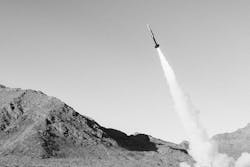
JOINT BASE MCGUIRE-DIX-LAKEHURST, N.J. – U.S. Navy hypersonic weapons experts needed to field affordable, mass-producible hypersonic missiles for the military. They found a solution from Castelion Corp. in Torrance, Calif.
Officials of the Naval Air Warfare Center Aircraft Division at Joint Base Mcguire-Dix-Lakehurst, N.J., announced a $50 million order to Castelion in late February for full-scale prototypes, flight testing, and operational fielding of the Blackbeard Hypersonic Weapons program.
Blackbeard is a tactical hypersonic strike missile designed to travel at speeds exceeding five times the speed of sound that emphasizes affordability and manufacturability to be built in large numbers.
The hypersonic missiles program includes variants for ground launch from the Army High Mobility Artillery Rocket System (HIMARS) and future Common Autonomous Multi-Domain Launcher (CAMDL) to replace the M270 Multiple-Launch Rocket System (MLRS) as part of the Army’s Long-Range Precision Fires modernization program. Blackbeard also is to be launchable from the Navy F/A-18 jet fighter-bomber.
Time-sensitive targets
Blackbeard is being designed to hit time-sensitive, mobile, or hardened targets. It is to be a relative low-cost weapon for frequent use to enhance artillery systems with hypersonic strike ability. Blackbeard is not meant to replace Army strategic hypersonic system like the Long Range Hypersonic Weapon, which focus on extreme range and velocity.
Blackbeard is engineered for industrial-scale production rather than limited builds. Its modular design, propulsion and guidance subsystems, and manufacturing approach aim to reduce costs to a fraction of traditional hypersonic rounds.
Castelion builds its own solid rocket motors and propulsion subsystems to reduce supply chain complexity and build hypersonic propulsion at volume. It integrates computers and guidance subsystems for precise navigation and target engagement in contested conditions. Blackbeard reportedly has terminal guidance that can be updated on the fly to attack moving or time-sensitive targets.
Extreme heat protection
Castelion is designing these hypersonic missiles with materials and thermal-protection systems to withstand the effects intense heat and drag.
Castelion was founded in late 2022 to focus on scalable, affordable hypersonic strike weapons. In 2025 the company switched from early experimental flights to military integration and evaluation. Late that year Castelion secured contracts from the Army and Navy to adapt Blackbeard for existing systems like HIMARS and CAMDL, as well as live-fire demonstrations with Army and Navy systems.
The project is moving from prototypes and integration to full-scale production readiness. This contract asks Castelion to build full-scale Blackbeard prototypes, conduct flight testing, and handle platform integration work.
Blackbeard targets
Typical Blackbeard targets will include mobile missile launcher; air-defense batteries and radar sites; command-and-control nodes; armored or mechanized units; forward-deployed logistics hubs; and coastal anti-ship missile systems that may appear briefly or move quickly.
These intended targets differ from those of the Long Range Hypersonic Weapon (LRHW), which seek to destroy targets like hardened command bunkers; major air bases; strategic missile sites; and deep-inland military infrastructure from extreme range against advanced air defenses.
On this order Castelion will do the work in Torrance, Calif., and should be finished by November 2027. For more information contact Castelion online at www.castelion.com, or Naval Air Warfare Center Aircraft Division at www.navair.navy.mil/lakehurst.
