Leidos moves forward with developing special forces small cruise missile for launch from light aircraft
Key Highlights
Questions and answers:
- What is the purpose of the Small Cruise Missile (SCM) program? It aims to develop a compact, long-range, precision-guided missile for stand-off strikes in support of special operations missions, allowing forces to stay at a safe distance.
- What contract did Leidos receive for the SCM program? Leidos received a $12.5 million contract from U.S. Special Operations Command to produce long-lead items needed to begin building the missile.
- How can the SCM be launched and what are its capabilities? The missile can be launched from light aircraft, drones, boats, or ground systems, and it is designed to fly about 400 nautical miles with low observability and precision targeting using GPS and inertial navigation.
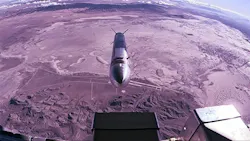
MacDILL AIR FORCE BASE, Fla. – U.S. special forces munitions experts are asking Leidos Inc. to prepare building a compact, long-range, precision-guided cruise missile for special operations forces to use for stand-off strike missions.
Officials of the U.S. Special Operations Command at MacDill Air Force Base, Fla., announced a $12.5 million contract to Leidos in Reston, Va., for long-lead items for the Small Cruise Missile program. Long-lead items involve components, materials, or subsystems that take a long time to deliver, and must be ordered well in advance of production.
The Small Cruise Missile (SCM) program for U.S. Special Operations Command (SOCOM) focuses on developing a compact, long-range, precision-guided missile for stand-off strike missions.
The SCM -- also called Black Arrow -- is to launch from smaller systems like light aircraft, uncrewed aircraft, boats, or small ground launchers, and is to strike targets at significant distances while keeping operators out of harm's way.
Navigation and guidance
The AGM-190 ASCM will use Global Positioning System (GPS) satellite navigation, inertial navigation, and sometimes imaging or terminal seekers for accuracy. It will have a low radar and infrared signature to evade detection and air defenses.
The SCM is to carry several different special forces weapons payloads, and will be for precision strikes in denied or sensitive environments in support of rapid, covert operations.
The program originated in 2022 under a Cooperative Research and Development Agreement (CRADA). The leading contractor is the Leidos Dynetics segment in Huntsville, Ala. Key subcontractors include Moog Inc. for flight control; and RTX Pratt & Whitney for the turbojet engine.
The SCM is to weigh about 200 pounds, will have a range of about 400 nautical miles, subsonic speed, and ceiling of about 30,000 feet. For more information contact Leidos Dynetics online at www.leidos.com/insights/dynetics, or U.S. Special Operations Command at www.socom.mil.
