Boeing moves ahead with E-7A radar surveillance aircraft, digital signal processing, and cyber security
Key Highlights
Questions and answers:
- What aircraft is the U.S. Air Force developing to replace the E-3 Sentry AWACS? The Air Force is developing the Boeing E-7A Wedgetail, which will replace the E-3 Sentry in the early 2030s.
- What is the purpose of the E-7A Rapid Prototype Airborne Mission Segment (AMS)? The AMS provides the mission systems—the “brains” of the aircraft—including radar processing, communications, battle management, and command-and-control capabilities.
- How is the E-7A different from the older E-3 AWACS aircraft? The E-7A is based on a Boeing 737 with a fixed “Top Hat” radar, uses modern digital systems and satellite integration, and is more advanced and modular than the E-3’s older rotating radar system.
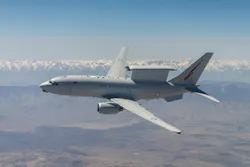
HANSCOM AIR FORCE BASE, Mass. – U.S. Air Force aerial surveillance experts are speeding-up development of new aircraft to replace the venerable E-3 Sentry Airborne Warning and Control System (AWACS) fleet for combat air traffic control.
Officials of the Air Force Life Cycle Management Center at Hanscom Air Force Base, Mass., announced a $2.3 billion order earlier this month to the Boeing Defense, Space and Security segment in Tukwila, Wash., for the E-7A Rapid Prototype Airborne Mission Segment project.
The E-7A Rapid Prototype Airborne Mission Segment (AMS) refers to a fast-tracked Air Force effort to field the mission systems necessary for the Boeing E-7 Wedgetail -- a next-generation airborne early warning and control (AEW&C) aircraft that is to replace AWACS in the early 2030s.
The Boeing E-7A Wedgetail is a modern replacement for the aging Boeing E-3 Sentry AWACS. The E-7A is based on the Boeing 737-700 single-aisle passenger jetliner, and has multi-role electronically scanned array (MESA) radar for air and maritime surveillance, battle management, command and control, and target tracking and identification.
Australian descendant
The E-7 is a direct descendant of the Royal Australian Air Force Wedgetail aircraft; they essentially are the same aircraft adapted for different operators.
Australia fielded the Wedgetail in 2012, and the U.S. Air Force later chose that same aircraft design to replace AWACS, which is based on the Boeing 707 four-engine passenger jet, which the Air Force first fielded in 1977. AWACS has the notable Frisbee-shaped rotating radar antenna on top of its fuselage.
The U.S. E-7A radar surveillance aircraft and the Australian Wedgetail aircraft use the same Boeing 737-based airframe; and large rectangular radar antenna mounted on top of the aircraft, which resembled a wide flat hat -- hence its nickname "Top Hat" -- which does not rotate like the AWACS radar does.
Networks and satellites
Compared to the Australian Wedgetail aircraft, the Air Force E-7 will have updated mission systems and software; integration with U.S. networks and satellites; and differences in communications, cyber security, and sensors.
The Airborne Mission Segment essentially is the brains of the E-7A aircraft. It includes radar digital signal processing systems; mission computing hardware; operator onboard battle-management workstations; communications and data links; and software for command and control, tracking, and targeting.
The E-7A project uses a rapid-prototyping approach for fast system fielding; risk reduction before full-scale production; integration of modular upgradeable systems; and to accelerate replacement of the aging E-3 fleet. Full-rate production of about 26 E-7A aircraft is scheduled for sometime next year.
Airborne mission systems
The E-7A Rapid Prototype Airborne Mission Segment project continues and expands E-7A airborne mission systems development; supports E-7A rapid prototyping; and advances mission-system capabilities like battle-management software; radar and communications integration; and command-and-control systems.
This order brings the total value of Boeing's E-7A contract to $4.9 billion. Boeing will do the work on this order in Seattle; Oklahoma City; Huntsville, Ala.; and Heath, Ohio, and should be finished by August 2032.
For more information contact Boeing Defense, Space & Security online at www.boeing.com/defense/patrol-early-warning-and-battle-management/e-7-aewc, or the Air Force Life Cycle Management Center at www.aflcmc.af.mil.