How targeting pods help fighter aircraft find and track targets
Key Highlights
- Targeting pods use visible and infrared sensors to detect objects across different conditions, including night operations.
- Stabilization systems like gimbals and inertial sensors keep sensors pointed accurately despite aircraft maneuvers and vibrations.
- Tracking software allows the system to follow moving targets within the image, enhancing engagement precision.
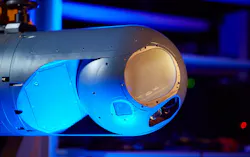
NASHUA, N.H. — A pilot can know roughly where to look for something on the ground without being able to identify it from the cockpit. Darkness and the aircraft's own movement can make that difficult long before weapons enter the equation.
Targeting pods give aircrews another set of eyes. Mounted outside the aircraft, these systems combine cameras, infrared sensors, lasers, stabilization and onboard processing to find and follow objects at long distances.
The U.S. Air Force's LITENING targeting pod is one example. The system has flown on vehicles including the F-15E, F-16, A-10 and B-52 and combines visible and infrared imaging with laser ranging and designation.
Those components work together, but they solve different problems. The sensor first has to produce a useful image. The pod then has to keep that image steady, follow whatever the aircrew selects and determine where it is.
Related: How aircraft decide which sensor data to trust
Visible and infrared sensors see the scene differently
A targeting pod does not rely on one camera for every condition. Visible-light sensors work with the portion of the electromagnetic spectrum people can see. Infrared sensors detect energy at wavelengths beyond visible light, giving crews another way to distinguish objects from their surroundings and operate at night.
The Air Force describes LITENING as combining a visible-light camera with forward-looking infrared (FLIR) imaging. Newer LITENING Large Aperture technology expands that approach with color daylight, mid-wave infrared, short-wave infrared and long-wave infrared sensors.
Different wavelengths can reveal different information because objects, materials and the atmosphere do not behave the same way across the spectrum. The viewing area matters, too. A wide field of view helps an aircrew search a larger area. Once something draws attention, a narrower field of view provides a closer look. LITENING supports both modes.
The pod has to stay pointed while the aircraft moves
Getting a detailed image is only useful if the sensor can remain pointed where the pilot wants it. That becomes harder from an aircraft moving hundreds of miles per hour. The vehicle can climb, bank and turn while vibration creates smaller movements. Meanwhile, the sensor may need to keep watching one small area on the ground.
Targeting pods use gimbals and stabilization to separate the sensor's line of sight from some of that aircraft motion. A gimbal allows the sensor assembly to point in different directions rather than simply looking wherever the nose of the aircraft happens to point.
LITENING incorporates an on-gimbal inertial navigation sensor for line-of-sight and boresighting functions. Northrop Grumman also says its current system uses continuous-roll imaging to maintain its view through aircraft maneuvers. This means an aircraft can change direction without necessarily forcing the targeting pod to stop looking at the same location.
Tracking solves a different movement problem
Stabilizing the picture does not guarantee that an object stays in the center of it, though. A vehicle on the ground may be moving at the same time as the aircraft. Tracking software helps the targeting system follow the selected object as its position within the image changes.
That requires processing the incoming imagery quickly enough to recognize changes from frame to frame and adjust where the sensor looks.
This is one area where improvements in computing can change what an existing pod can do. Northrop Grumman's Large Aperture configuration pairs its sensors with a more powerful graphics processing unit and updated video-processing algorithms. The company says the system boosts image resolution by 50% compared with the previous configuration.
Lasers add information that a camera cannot
Once the aircrew can see and follow something, another question remains: how far away is it? A laser rangefinder can help answer that. It sends energy toward a point and uses the return to determine distance.
A laser designator performs a different job. It illuminates a target with coded energy that a compatible laser-guided weapon can use during an engagement. LITENING incorporates both ranging and designation capabilities, along with a laser spot tracker that can detect energy placed on a location by another source.
Seeing something does not mean knowing exactly where it is
A targeting pod can produce a clear image of a vehicle without automatically knowing that vehicle's geographic coordinates. But the system has to combine several pieces of information to make that calculation. Specifically, it needs to know how the aircraft is oriented, where the sensor is pointing and how far away the observed location is.
Alignment matters because even a small error in where the system thinks the sensor is pointing can create a larger error in the calculated location at greater distances. LITENING uses line-of-sight determination and automatic boresighting to maintain the relationship between the pod and aircraft reference frame.
Once the system establishes a location, that information can become useful beyond the image itself. Coordinates can support other aircraft systems and weapons while video and other information can be shared with forces elsewhere.
The Air Force has used LITENING's video downlink to share imagery with personnel on the ground, while current versions support secure two-way data links.
Targeting pods can evolve without redesigning the aircraft
Targeting pods still perform many of the same basic functions, even as the electronics inside them have changed. New sensors can improve what the pod sees. Faster processors can handle more imagery, while updated software can change how the system detects and tracks objects. Data links can then connect that information with other parts of a network.
A podded architecture also gives engineers a way to make some of those changes separately from the aircraft carrying it. Northrop Grumman describes LITENING as modular and says it can be installed on standard weapon stations without aircraft modifications.
The company has also used software updates to expand the system's capabilities. Northrop Grumman recently described modifying LITENING software so F-16s could use the pod while employing laser-guided rockets against fast-moving aerial targets.
From the outside, a targeting pod can look like one more piece of equipment hanging beneath an aircraft. Inside, the job is split among sensors, optics, lasers, processors and stabilization hardware, each handling a different part of turning something in the distance into information an aircrew can use.
About the Author
Samantha McGrail
Associate Editor
Related
Voice Your Opinion!
To join the conversation, and become an exclusive member of Military Aerospace, create an account today!
 Leaders Logo
Leaders relevant to this article: