Light-emitting diodes (LEDs) for electro-optics uses like infrared imaging introduced by EPIGAP OSA
Summary points:
- EPIGAP OSA launches new OCI-460 SWIR LED series with enhanced performance for imaging through dust, fog, and smoke in defense and security applications.
- Extended wavelength range of 700 to 1650 nanometers delivers versatility for sensing, machine vision, and gas detection.
- As much as a 96 percent increase in output power at 1550 nanometers and 13 percent higher efficiency than previous models, optimized for reliability and long operating life.
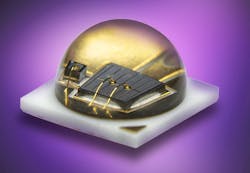
BERLIN – EPIGAP OSA Photonics GmbH in Berlin is introducing the OCI-460 SWIR LED series surface-mount device (SMD) shortwave infrared (SWIR) light-emitting diode (LED) for improved infrared imaging through dust, fog and smoke; target detection and recognition; and surveillance and security applications.
The electro-optics device offers more output power and an extended product range from 700 to 1650 nanometers than is available currently in today's market.
The OCI-460 SWIR LED series model OCI-460 ID1550-XS operates at 1550 nanometers and features drive current to 1.5 amps to deliver approximately 13 percent higher output efficiency over EPIGAP's OCI-480 device.
Increase in output power
This advancement is a 96 percent increase in output power at 1550 nanometers and delivers 150 milliwatts. Other SWIR LED models in the OCI-460 series operate at wavelengths of 1040 nanometers, 1200, 1300, 1460, and 1650 nanometers.
EPIGAP OSA's SMD SWIR light-emitting diodes (LEDs) feature an industry-standard 3535 size with a ceramic package and silicone dome for thermal performance. Designed for sensing, machine vision, and gas-sensing applications, each OCI-460 series device integrates electrostatic discharge (ESD) protection to ensure long operating life and reliable performance.
For more information contact EPIGAP OSA Photonics online at www.epigap-osa.com/led-smd/ir-smds.
About the Author
John Keller
Editor-in-Chief
John Keller is the Editor-in-Chief, Military & Aerospace Electronics Magazine--provides extensive coverage and analysis of enabling electronics and optoelectronic technologies in military, space and commercial aviation applications. John has been a member of the Military & Aerospace Electronics staff since 1989 and chief editor since 1995.