Boeing to build test and measurement system with artificial intelligence (AI) to validate LRUs
Key Highlights
Questions and answers:
- What is the purpose of the U.S. Army’s Next Generation Automated Test System (NGATS)? To enable maintainers to perform depot-level repairs on the battlefield. It helps diagnose and repair electronic components of weapon systems, reducing downtime and improving maintenance efficiency.
- How does NGATS use artificial intelligence (AI)? The system applies AI and machine learning to analyze historical test data, predict potential failures, and estimate component lifespan. This predictive capability helps identify root causes of faults in real time and reduces the need for manual troubleshooting.
- What military systems can NGATS support and test? NGATS has an open, reconfigurable architecture that supports the testing of digital and analog hardware and software in systems like the M1 Abrams tank, Bradley Fighting Vehicle, Paladin artillery, and Apache helicopter.
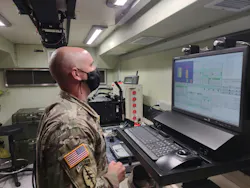
Newark, N.J. – U.S. Army test and measurement experts needed a system to enable maintainers to perform depot-level repairs on the battlefield to improve maintenance and reduce system downtime. They found a solution from the Boeing Co. Defense, Space, & Security segment in St. Louis.
Officials of the Army Contracting Command in Newark, N.J., announced a $25.5 million order to Boeing in late December for Next Generation Automated Test System (NGATS) production. The modification brings the total cumulative face value of the contract to $144.1 million.
NGATS is a U.S. Army diagnostic tool designed for field troubleshooting of electronic line replaceable units (LRUs) in weapon systems. It enables maintainers to perform depot-level repairs forward on the battlefield to reduce system downtime.
NGATS offers a mobile, modular setup housed in two 20-foot ISO containers with a 60-kilowatt generator, compatible with Army load-handling vehicles for rapid deployment. The system test digital and analog hardware and software via self-diagnostic capabilities, including built-in test (BIT) equipment and artificial intelligence (AI) for fault isolation.
Artificial intelligence (AI)
NGATS uses AI for prognostic and predictive maintenance by analyzing historical test data to forecast failures and estimate usable life of electronic components. It uses AI-driven machine learning algorithms to process parametric data from organizational and intermediate maintenance levels to link failures to historical trends for real-time root cause analysis.
This helps forecast defects, reduce test cycles, and improve fault isolation without extensive manual intervention. NGATS connects to networks like the U.S. Marine Corps Global Combat Support System–Marine Corps (GCSS-MC) and Marine Corps Enterprise Network (MCEN) for data aggregation.
This supports expert systems that identify corrective actions, spares availability, and replacement timelines in one operation. AI enhancements are being phased in, starting with legacy system upgrades for automated diagnostics across Army electronic systems.
NGATS features an open architecture with commercial technologies for reconfigurability, testing on digital, analog hardware, and software on military systems like M1 Abrams tanks, Bradley Fighting Vehicles, and Paladin self propelled artillery.
Self-test functions
The system includes automated test equipment, several test program sets, and self-test functions that help eliminate manual tools like multimeters or oscilloscopes.
NGATS mounts on two heavy expanded-mobility tactical trucks pulling 20-foot ISO shelters, plus a 60-kilowatt generator for power. This setup integrates with Army load-handling vehicles for rapid deployment and repositioning on the battlefield.
Maintainers load LRUs into the ATE, run TPS diagnostics to isolate faults, and verify repairs via self-tests and operational checks. The system processes vehicle electronic circuit cards, and helps confirm durability by driving off-road, unloading, and re-testing components.
Reconfigurable design
The NGATS reconfigurable design replaces legacy systems like the 1980s-vintage Direct Support Electrical Systems Test Set (DSESTS) and Base Shop Test Facility (BSTF). Army leaders say they expect to field 181 NGATS units including non-sheltered consoles.
Testing occurred at Aberdeen Proving Ground, Md., in 2020 to validate mobility through off-road durability checks and self-tests. Boeing delivered the 100th NGATS unit in 2023 for ground vehicle diagnostics. Upgrades in 2025 added aviation test programs for Apache helicopters. NGATS uses machine automation to cut maintenance time by 25 percent and eliminate tools like multimeters and paper manuals.
On this order, Boeing will do the work at locations to be determined with each order, and should be finished by December 2027. For more information contact Boeing Defense, Space & Security online at https://services.boeing.com/news/faster-field-test-repair-apache-ngats.
