Air Force considers plan to re-open Hypersonic Test Facility that relies on non-combustion heating
Key Highlights
Questions and answers:
- Why is the U.S. Air Force considering reactivating the Hypersonic Test Facility in Ohio? To test and evaluate hypersonic aircraft and missile designs using a high-temperature, clean-air wind tunnel that more accurately simulates real atmospheric conditions than current facilities.
- How does the Ohio Hypersonic Test Facility generate hypersonic airflow and heat conditions? It heats nitrogen gas to extreme temperatures using a 3-megawatt electrically powered graphite core storage heater, then expands it through a nozzle to produce Mach 5–7 air flow and heat for testing.
- What is the planned timeline for reactivating the facility? The project is expected to take 18–24 months, in two phases: reactivation (upgrading obsolete components) and demonstration (proving the system works).
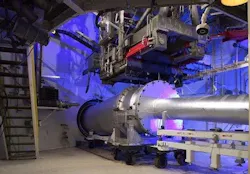
EGLIN AIR FORCE BASE, Fla. – U.S. Air Force test and measurement experts are considering the reactivation of a high-velocity wind tunnel in Ohio to test and evaluate hypersonic aircraft and munitions designs.
Officials of the Air Force Test Center (AFTC) at Eglin Air Force Base, Ohio, have issued a sources-sought notice (FA248626RB002) for the Hypersonic Test Facility Reactivation project to re-open the Hypersonic Test Facility (HTF) at the NASA Armstrong Test Facility in Sandusky, Ohio, which has been mothballed since 2007.
This wind tunnel test facility is designed to simulate the heat and atmospheric conditions of hypersonic flight at speeds from Mach 5 to Mach 7 using a non-combustion heating process. Evaluations have determined that this site is viable for reactivation.
The Air Force needs to re-open this test facility to continue development of scramjet technologies to develop and mature enabling technologies in hypersonic aircraft and missiles, Air Force researchers say. Hypersonic refers to speeds in excess of five times the speed of sound.
Inadequate test facilities
Today the only active hypersonic test facilities available to the Air Force are the eight-foot High Temperature Tunnel (HTT) at the NASA Langley Research Center in Hampton, Va., and the Aerodynamic and Propulsion Test Unit (APTU) at the he Arnold Engineering Development Complex in Tullahoma, Tenn.
The HTT and APTU are considered inadequate for today's hypersonic flight testing because they have gas properties that are different from atmospheric air, which can affect ground test conditions.
Instead, the high-temperature non-vitiated clean-air ground test capability of Ohio's Hypersonic Test Facility is considered paramount, experts say. This facility uses a non-combustion heating process that is free of combustion byproducts.
The Ohio test facility can heat nitrogen gas to extreme temperatures by passing it through an electrically powered three-megawatt graphite core storage heater that heats the gas to very high temperatures before expansion through a nozzle to reach hypersonic flow conditions.
Two-year project
Reactivating the Ohio hypersonic test facility should take 18 to 24 months, and will be done in two phases: reactivation and demonstration. Reactivation will recondition or develop new components to replace obsolete parts that involve heater and hot train controls and power distribution. Demonstration will show that everything works.
Companies interested in taking-on this job should email 50-page capability statements no later than 19 March 2026 to the Air Force's David Thomas at [email protected], with a copy to Amanda Jardine at [email protected].
Email questions or concerns to David Thomas at [email protected], or Amanda Jardine at [email protected]. More information is online at https://sam.gov/workspace/contract/opp/dac77044ecc246909cea34bb6458e252/view.
