PATUXENT RIVER, Md. - Naval Air Systems Command has awarded DRS Systems Inc. a $19.8 million contract order for additional test equipment to expand production testing capacity for the Navy's Distributed Aperture Infrared Countermeasure (DAIRCM) aircraft survivability system.
The firm-fixed-price order covers five far-field test stations, two fiber-optic cable assembly kits for AH-1Z integration, four fiber adapter sets, two Laser 2 assemblies, eight Laser 2 sources, and associated hardware and technical data deliverables. Work will be performed in San Diego and Dallas, and is expected to be completed in November 2027.
DAIRCM background
DAIRCM, designated AN/AAQ-45, is an integrated aircraft survivability system that combines infrared missile warning, laser warning, hostile-fire indication, and directed-infrared countermeasures. Its sensors detect incoming threats, while a central processing system analyzes the information and coordinates the appropriate response. The directed-infrared countermeasure uses laser energy to interfere with the guidance of certain infrared-guided missiles, providing an aircraft with a defensive capability beyond conventional warning and expendable decoys.
Related: L3Harris receives $876.4M modification for Next Generation Jammer Low Band
The system's technical architecture draws on two-color infrared focal-plane arrays for threat sensing, missile and hostile-fire detection algorithms, quantum cascade lasers, and infrared fiber-optic cables that can transmit high optical power. These technologies combine electro-optical sensing, signal processing, and directed infrared energy in a modular system designed for aircraft with demanding size, weight, and integration requirements.
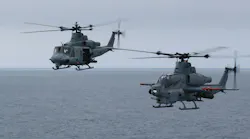
Leonardo DRS identifies the AH-1Z Viper attack helicopter and UH-1Y Venom utility helicopter as platforms for the system. The company says it has deployed DAIRCM on aircraft operating under a Joint Urgent Operational Need Statement.
The new order is intended to expand the industrial capacity to test DAIRCM sensors during production. A June 2026 NAVAIR procurement notice described the requirement as support equipment to increase sensor production testing capacity, including far-field test stations, Laser 2 hardware for those stations, DAIRCM test hardware, and data deliverables. The notice does not specify the precise sensor characteristics or performance parameters measured by the stations.
Related: Leonardo DRS wins NAVAIR contract for aircraft survivability system
In a separate action, NAVAIR awarded DRS a three-year indefinite-delivery/indefinite-quantity contract for DAIRCM low-rate initial production. The contract has a ceiling of approximately $533.3 million and provides for production of up to 690 sensors, 134 processors, and 134 Laser I units, along with fiber-optic cable assemblies, engineering support, and test equipment for Navy and Army requirements. The ceiling is not a guaranteed purchase amount; funding is obligated through individual orders as they are issued.
The November order was not competitively procured. NAVAIR identified DRS as the sole designer, developer, and manufacturer of the required equipment and said the government does not own a technical data package for AN/AAQ-45 suitable for competition.
Fiscal 2027 Navy aircraft procurement funds of $18.1 million and fiscal 2026 Navy research, development, test, and evaluation funds of approximately $1.7 million will be obligated when the order is placed.