Chung-Ang University's AI-driven defect detection could improve safety and reliability across industries
Summary Points:
- Researchers at Chung-Ang University in Seoul, South Korea, developed DiffectNet, an AI-based defect reconstruction system.
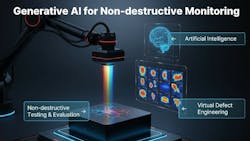
- The system uses diffusion-enabled neural network techniques to improve ultrasonic imaging for non-destructive testing.
- Potential applications include aerospace, power generation, semiconductor manufacturing, and civil infrastructure.
SEOUL, South Korea - Researchers at South Korea's Chung-An University have developed an artificial intelligence (AI)-based approach that could improve how internal material defects are detected and analyzed in industrial systems. The method, called DiffectNet, is designed to reconstruct internal structural flaws with greater precision than conventional non-destructive testing (NDT) techniques.
Non-destructive testing enables engineers to inspect the internal condition of materials without causing damage, but physical sensor signals, such as ultrasonic or electromagnetic waves, can be distorted by complex factors, including geometry, material composition, and environmental conditions. These distortions make it difficult to pinpoint the exact size and location of internal cracks or voids.
A research team led by Sooyoung Lee, assistant professor and principal investigator of the Industrial Artificial Intelligence Laboratory in the School of Mechanical Engineering at Chung-Ang University, developed DiffectNet to address those limitations. The system uses a diffusion-enabled conditional target generation network to produce defect-aware ultrasonic images that represent internal structures with higher fidelity.
Related: Archer Aviation, Palantir partner on AI for next-gen aviation
The study was published online on 30 September 2025 and appears in Volume 240 of the journal Mechanical Systems and Signal Processing, dated 1 November 2025.
Overcoming limitations
According to Lee, integrating AI into traditional NDT methods could help overcome physical limitations inherent in current inspection processes. The technology aims to reconstruct internal features in real time, enabling earlier detection of potential failures and supporting continuous structural monitoring.
Possible applications include power generation, semiconductor fabrication, and critical infrastructure such as bridges and buildings. In these sectors, even minor structural anomalies can have significant safety or operational implications. Real-time AI-assisted monitoring could enhance quality control, reduce downtime, and improve preventive maintenance planning.
The researchers suggest that AI-enabled NDT could play an important role in improving reliability and safety standards across industries where system integrity is critical, including aerospace, energy, and manufacturing.
About the Author
Jamie Whitney
Editor-in-Chief
Jamie Whitney joined the staff of Military & Aerospace Electronics in 2018 and oversees editorial content and produces news and features for Military & Aerospace Electronics, attends industry events, produces Webcasts, and oversees print production of Military & Aerospace Electronics.
Related
Voice Your Opinion!
To join the conversation, and become an exclusive member of Military Aerospace, create an account today!
 Leaders Logo
Leaders relevant to this article: