Vector network analyzers for artificial intelligence (AI) testing introduced by Rohde Schwarz
Summary points:
- High-frequency R&S ZNB3000 models reach frequencies as high as 54 GHz for next-generation AI, 5G, and satellite testing.
- Designed for PCI Express 7.0 and other ultra-high-speed interconnects that require high-bandwidth performance.
- Offers 150 decibels of dynamic range, ultra-low trace noise, and scalable frequency upgrades for flexible lab and production use.
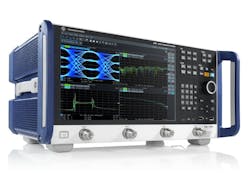
MUNICH – Rohde & Schwarz in Munich is introducing high-frequency models of the company's the R&S ZNB3000 vector network analyzer to characterize high-speed circuit boards, cables, and interconnects in artificial intelligence (AI) applications.
The R&S ZNB3000 vector network analyzers cover frequencies as high as 54 gigahertz. AI applications demand ultra-fast, high-bandwidth interconnects to handle massive data loads efficiently.
The PCI Express 7.0 standard under development will double the supported data rates to 128 gigatransfers per second, which requires testing at higher frequencies.
Frequencies to 54 GHz
Covering 54 GHz, the R&S ZNB3000 test and measurement instruments include PCI Express cables as the device under test (DUT), and show how to ensure the reliability of high-speed interconnects for AI-driven workloads.
The R&S ZNB3000 family offers RF performance with a high dynamic range of 150 decibels, high output power, and trace noise of less than 0.0015 decibels RMS.
The models offer ultra-fast measurement speed; low start frequency of 9 kHz; and flexible frequency upgrades. Users can start with a base unit and expand the maximum frequency later by purchasing upgrade options.
Tell me more about vector network analyzers ...
- A vector network analyzer (VNA) measures scattering parameters or S-parameters of RF and microwave devices like filters, amplifiers, antennas, and cables. A VNA characterizes how signals behave when they pass through or reflect from a device under test, such as magnitude and phase of reflected and transmitted signals; and impedance, return loss, insertion loss, and VSWR to help engineers understand how a device transmits power and whether it causes unwanted reflections or losses. Vector network analyzers generate and split signals, measure transmitted and reflected signals, and compares amplitude and phase between the reference and measured signals. Applications include measuring filters, amplifiers, and antennas; tuning antennas; measuring dielectric properties, and calibrating and verifying other RF equipment.
The high-frequency models support RF component testing for satellite communications applications in the Ka and V bands, such as filters, mixers, amplifiers, switches, and beamformers.
The vector network analyzers also enable testing for 5G, 6G and Wi-Fi applications in production environments and research labs working on next-generation technologies.
The frequencies 32 GHz, 43.5 GHz and 54 GHz of the R&S ZNB3000 will be available by the end of this year. For more information contact Rohde & Schwarz online at www.rohde-schwarz.com/products/test-and-measurement/network-analyzers/rs-znb3000-vector-network-analyzer_334291.html.