Emerson targets aerospace RF testing with new NI CHESS emulation software
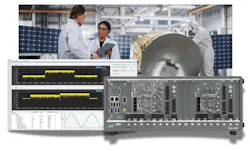
AUSTIN, Texas - Emerson's NI business in Austin, Texas, introduced its NI Channel Emulator System Software (CHESS) platform, a software-defined radio frequency test and validation platform designed to help aerospace and defense engineers emulate mission-critical RF communications links in laboratory environments, rather than relying solely on field testing.
The NI CHESS platform operates with Emerson’s NI PXI Vector Signal Transceiver hardware to emulate dynamic RF environments in real time for aerospace, satellite, and defense communications systems. The platform is intended to support the validation of ground-to-orbit, ground-to-air, and airborne communications links under controlled, repeatable laboratory conditions.
According to Emerson, the platform combines model-based simulation with hardware-in-the-loop execution to inject RF impairments such as Doppler shift, multipath fading, path loss, and interference into test environments through FPGA co-processing and third-party scenario-generation tools.
The company said the approach enables engineers to identify RF performance issues earlier in development cycles and reduce dependence on costly late-stage field testing campaigns. The platform is designed to support repeatable validation workflows intended to reduce logistical complexity, redesign efforts, and schedule delays associated with field-based testing.
The NI CHESS architecture supports multi-channel, wideband RF test environments for increasingly complex aerospace and satellite communications systems, without requiring major redesigns of existing test configurations.
Chris Behnke, director of aerospace and defense RF test and validation systems at Emerson, said the increasing complexity of aerospace communications systems and the rising cost of field testing are driving demand for more realistic, laboratory-based RF validation capabilities. He said the platform is intended to help engineers validate RF performance earlier in development, reduce program risk, and control testing costs.
Because the platform is software-based and integrates with existing NI PXI RF infrastructure, Emerson said users can deploy the capability within current laboratory environments while expanding RF test coverage and validation capabilities.
For more information, please visit www.ni.com.