Why cybersecurity is becoming a core requirement in military embedded systems
Key Highlights
- Modern military platforms process vast amounts of data and rely on open architectures, increasing attack surfaces and necessitating integrated cybersecurity from the outset.
- Zero Trust principles are being adapted for embedded systems, requiring continuous verification of hardware, software, and communications to contain potential intrusions.
- Trusted computing involves hardware roots of trust, secure boot, and component verification to ensure system integrity and reliability in operational environments.
- Software supply chain security is critical, with tools like SBOMs helping identify vulnerabilities in third-party components used across defense systems.
- Defense organizations are proactively planning for quantum-resistant cryptography to safeguard communications and data against future quantum computing threats.
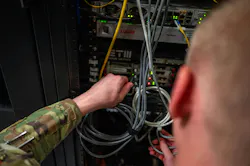
NASHUA, N.H. – Modern military platforms process and exchange more information than ever before. Aircraft, satellites, electronic warfare systems, autonomous vehicles, and ground platforms routinely share data across distributed networks while running increasingly sophisticated software at the tactical edge. Open architectures and software-defined capabilities have expanded what these systems can do, but they have also dramatically increased potential attack surfaces.
That shift is changing the way engineers approach cybersecurity.
For years, cybersecurity often focused on protecting networks from outside attackers. Firewalls, intrusion detection systems, and encrypted communications formed the first line of defense. Those protections remain important, but they are no longer enough for embedded systems that may spend years operating in contested environments or communicating across multiple domains.
Instead, cybersecurity has become part of the engineering process itself. It now influences decisions made long before a platform ever reaches the field, from processor selection to supply chain management.
The goal has also evolved. Defense programs no longer assume they can prevent every intrusion. And now, engineers are designing systems that authenticate every connection and continue operating even if part of the platform becomes compromised.
That shift is reshaping trusted computing across the aerospace and defense industry.
Zero Trust moves beyond the data center
Zero Trust first gained traction as a concept in enterprise IT, where organizations stopped assuming that users or devices inside a network should automatically be trusted. Instead, every request for access must continuously prove its legitimacy.
Rather than trusting users or devices simply because they are already inside a network, Zero Trust verifies identity each time someone or something attempts to access data, applications, or other system resources. That approach helps lessen the risk that a single compromised account or device can move freely through a system.
That same idea is now shaping military embedded systems. As platforms integrate software-defined radios, mission computers, edge AI processors, and distributed sensors, engineers are increasingly verifying users, hardware, software, and communications throughout a mission instead of assuming every component can be trusted.
The objective is to contain the effects of an intrusion rather than allow a single compromised component to affect the entire platform.
Although the underlying philosophy remains the same, applying Zero Trust to embedded systems looks very different than implementing it in a corporate network. A fighter aircraft, autonomous vehicle, or electronic warfare platform cannot rely on continuous cloud connectivity or centralized identity services. Instead, many of the same principles are built directly into the hardware and software running onboard.
"Zero Trust is less mature in the embedded world, but key concepts, such as only executing properly signed software and continuous monitoring, are widely used,” Steve Edwards, director of secure embedded solutions at Curtiss-Wright Defense Solutions, told Military & Aerospace Electronics in a recent interview.
Edwards says Zero Trust is still evolving within embedded defense systems, but many of its core ideas are already becoming standard practice.
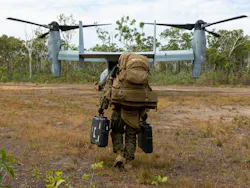
Those ideas are becoming especially important as military systems integrate more autonomous functions and process larger volumes of mission data at the edge. Every new interface, sensor, and software module creates another opportunity for compromise unless the system can continuously verify what it trusts.
Trusted computing starts with the hardware
Before software can protect a mission, the underlying hardware has to establish that it is genuine and operating as intended. That idea sits at the heart of trusted computing. At its simplest, trusted computing means that “the correct hardware, operating in its intended state and executing only the software it is meant to execute, is being used," Edwards said.
He goes on to say that trust extends beyond simply preventing cyberattacks. "Trusted computing ensures the integrity of the system so that it operates reliably when deployed. If the system is compromised, performance could be degraded or not function at all when needed, which puts our warfighter in danger."
That process begins as soon as the system powers on.
Many modern embedded systems use a hardware root of trust, a dedicated security function that establishes the platform's identity before the rest of the system starts. It validates firmware, verifies digital signatures, and confirms the boot process has not been altered. Only after those checks succeed can the remainder of the software begin loading.
Secure boot builds on that foundation by ensuring every stage of the startup process confirms the integrity of the next. If malicious code is inserted anywhere along the chain, the system can stop the boot process before compromised software begins running.
Together, those mechanisms prevent attackers from replacing trusted software with malicious code. Unlike application software, firmware operates close to the hardware itself, making it particularly attractive to attackers seeking persistent access.
Trusted computing also extends to the physical hardware entering a platform. Military programs must verify every component because counterfeit electronics, unauthorized substitutions, and compromised parts can introduce vulnerabilities long before a system reaches operational service.
As defense supply chains continue expanding across global manufacturers, ensuring component authenticity has become another important part of trusted computing. The result is a layered approach. Hardware establishes trust, firmware confirms system integrity, and software inherits that trusted foundation before mission applications begin executing.
Software supply chains become part of cybersecurity
Modern mission computers depend on software from dozens of different sources. Operating systems, bootloaders, open-source libraries, security packages, and mission applications often come from numerous developers before being integrated into a single platform.
Instead of targeting an individual aircraft or vehicle, attackers increasingly look for opportunities higher in the software supply chain. Compromising a commonly used component or development tool can create a pathway into many different systems built on the same foundation.
Edwards says that complexity creates opportunities for attackers long before equipment reaches the field.

"The supply chain is the fastest-growing problem, both hardware and software. Every fielded system depends on a long stack of code: BIOS, bootloader, operating system, drivers, applications, and third-party libraries written and maintained by vendors and open-source contributors all over the world."
"An adversary does not have to attack every deployed unit if they can compromise a build system, update channel, or upstream component once by targeting the shared libraries and services hundreds of downstream programs are built on,” he said.
Instead of reviewing only the code they write, they increasingly examine every software component that becomes part of the finished system. Security teams routinely scan applications against Common Vulnerabilities and Exposures (CVE) databases, evaluate Common Weakness Enumeration (CWE) listings, and monitor newly disclosed vulnerabilities throughout a product's operational life.
Software Bills of Materials, commonly known as SBOMs, have also become an important tool. Much like an aircraft parts list, an SBOM documents every software component included in a system. If researchers later discover a vulnerability in a widely used library, manufacturers can quickly determine whether affected code exists in deployed platforms. That visibility becomes especially valuable when new vulnerabilities emerge.
Unlike commercial electronics that companies can replace every few years, defense platforms often remain in service for decades. Software selected during development may still require maintenance long after the original hardware components have changed.
Preparing for the post-quantum era
Many cybersecurity discussions focus on today's threats, but defense organizations are increasingly planning for one that has not yet fully arrived.
Quantum computing has the potential to solve certain mathematical problems far more quickly than today's computers. That matters because many of the encryption methods used to protect military communications, software updates, and stored information rely on mathematical problems that today's computers cannot realistically solve.
Regardless of when large-scale quantum computing arrives, defense programs cannot afford to wait. Aircraft, satellites, naval vessels, and ground systems often remain in service for decades. Information collected today may still need to remain protected decades from now.
That concern has given rise to what cybersecurity professionals often describe as a "harvest now, decrypt later" strategy. An adversary can intercept and store encrypted communications today, then attempt to decrypt that information years from now using more capable quantum computers.
Edwards says defense acquisition teams can no longer treat post-quantum security as a future problem. "The post-quantum transition is not theoretical for acquisition anymore. Adversaries can record encrypted traffic now and try to decrypt it later."
That transition is already underway across the defense community. The National Security Agency's Commercial National Security Algorithm (CNSA) 2.0 guidance calls for new National Security System acquisitions to support quantum-resistant cryptography beginning in 2027. Many programs entering development today already need to account for future cryptographic requirements.
Unlike software updates on a smartphone, replacing cryptographic infrastructure on an aircraft or satellite after deployment can require years of engineering, testing, certification, and fielding.
As a result, engineers view quantum readiness as another design consideration rather than a future upgrade. Preparing now reduces the need for costly redesigns after platforms enter service.
Artificial intelligence changes both sides of cybersecurity
Artificial intelligence (AI) is becoming another major influence on trusted computing, but not simply because more defense platforms are incorporating AI into their missions. Instead, AI is changing how organizations defend systems and how adversaries attack them.
As more mission systems rely on AI for decision support and sensor processing, protecting those algorithms becomes part of protecting the platform itself.
Developers are already using AI to analyze network activity, identify vulnerabilities, and prioritize security alerts far more quickly than manual methods allow. Adversaries are exploring many of the same capabilities, using AI to automate vulnerability discovery and search large codebases for weaknesses.
Edwards expects AI to become increasingly important for both defenders and attackers.
"Recent advances in AI and its ability to detect and exploit code vulnerabilities will increase the criticality of having robust code and timely fixes." As AI capabilities continue to mature, protecting AI-enabled mission systems will become increasingly important alongside using AI to strengthen cybersecurity.
Military platforms now rely on AI to process sensor data, recognize targets, support electronic warfare, and assist operators during time-sensitive missions. If an adversary can manipulate the data feeding those algorithms and interfere with model integrity, the effects could expand well beyond traditional cybersecurity concerns.
That possibility has encouraged developers to think more broadly about securing AI throughout its lifecycle, from software development and model training to deployment and long-term maintenance.
Rather than treating AI as a separate capability, many organizations now consider it another critical workload that they must protect alongside every other mission application.
Building systems that continue operating under attack
Perhaps the biggest change in military cybersecurity is philosophical. For years, security strategies largely focused on preventing attackers from getting inside a system.
Today's engineers recognize that no protection is perfect. Instead of assuming that companies can stop every intrusion, many engineers are designing systems with the expectation that some level of compromise may eventually occur. The objective then becomes limiting the damage, protecting mission-critical functions, and continuing to operate despite the attack.
Edwards says that shift has fundamentally changed how engineers approach new programs.
"We are also seeing cybersecurity considered up front, rather than as an afterthought. This is a very positive change because many systems cannot be fully secured unless considered early in the development process."
Integrating security into a platform from the very beginning allows engineering teams to build trusted hardware, authenticated software, and protected update mechanisms into the architecture rather than retrofitting them after development is largely complete.
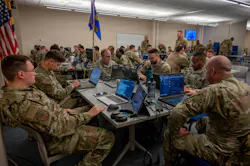
It also reflects an important reality. Military systems rarely share the same cybersecurity requirements. A platform processing classified intelligence faces different risks than one supporting logistics or training operations, so engineers increasingly tailor protections to the mission rather than applying the same security model everywhere.
"Each system has different cybersecurity needs, so there is no one-size-fits-all approach," Edwards says. That approach allows engineers to build secure-by-design platforms without applying the same cybersecurity model to every mission.
Trust becomes another engineering requirement
Cybersecurity has traditionally been viewed as a discipline separate from embedded computing, but that distinction is fading. Today's engineers are making cybersecurity decisions alongside processor selection, thermal management, power budgets, networking, and software architecture because each influences the overall resilience of the platform.
Together, these developments point to a broader shift in military embedded computing. Cybersecurity is no longer a feature added near the end of the design process. It now influences architecture decisions from the earliest stages of a program.
The future of trusted computing is not about creating platforms that can never be compromised. It is about engineering systems that can verify their integrity, adapt to new threats, recover when attacks occur, and continue supporting the mission when it matters most.
About the Author
Samantha McGrail
Associate Editor
Related
Voice Your Opinion!
To join the conversation, and become an exclusive member of Military Aerospace, create an account today!
 Leaders Logo
Leaders relevant to this article: