Navy surveys industry for reusable uncrewed test aircraft to develop air-launched munitions
Key Highlights
Questions and answers:
- What is the U.S. Navy seeking from industry? A prototype reusable uncrewed test aircraft to support faster development and testing of air-launched munitions.
- What capabilities should the uncrewed test aircraft have? Ability to carry and release 500-to-1000-pound munitions, support for rapid turnaround between flights, and feature modular interfaces for integrating different weapons and capturing test data.
- Why does the Navy want a reusable uncrewed test aircraft? To reduce costs, increase testing frequency, and enable continuous, fast-paced experimentation with new weapons technologies under realistic flight conditions.
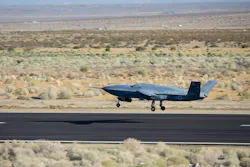
CHINA LAKE NAVAL WEAPONS STATION, Calif. – U.S. Navy aerial weapons experts are surveying industry for companies able to build a prototype uncrewed test aircraft to accelerate development of air-launched munitions.
Officials of the Naval Air Warfare Center-China Lake issued a sources-sought notice (N6893626RFPREQD0AH3000002) last Thursday for the Reusable, Unmanned Developmental Test and Evaluation (DT&E) Platform project.
The intent to gain knowledge of interest, capabilities and qualifications of industry to explore approaches that support continuous testing cycles that enable fast-paced experimentation.
Reusable uncrewed aircraft
Navy experts are considering an uncrewed reusable system to reduce costs and increase test frequency that can carry and release 500-to-1000-pound munitions. Solutions should be affordable, scalable, and flexible enough to integrate new technologies quickly for evaluation in naval aviation flight conditions.
From industry, Navy experts want responses that describe the system architecture for an uncrewed, reusable system, as well as ground and mission support; integration approach to support several munitions types and instrumentation; and safety and risk management of high-cadence testing.
Prototype uncrewed test aircraft should have mission support tools sufficient to demonstrate core capability; modular interfaces for munitions integration and data capture; and test plans and metrics for assessing readiness and applicability.
Rapid turnaround
This reusable uncrewed test aircraft should offer rapid turnaround between flights, with plans for maintenance, logistics, and safety-of-flight and ground operations. Also of interest is the technology readiness level of proposed solutions.
Companies interested should email capability statements no later than 3 April 2026 to the Navy's Ciera Wood at [email protected] and Caitlan Johnson at [email protected].
Email questions or concerns to Ciera Wood at [email protected] and Caitlan Johnson at [email protected]. More information is online at https://sam.gov/workspace/contract/opp/d71555a5a6704e5abb1393c9eafdcc99/view.
