AeroVironment to build 55-pound long-range surveillance uncrewed aircraft for Army platoons and companies
Key Highlights
Questions and answers:
- What solution did the U.S. Army choose for small-unit long-endurance ISR needs? The Army selected the AeroVironment P550 long-range reconnaissance uncrewed aircraft.
- What are some key capabilities of the P550? The P550 can stay airborne for up to five hours, carry a 15-pound sensor payload, operate without traditional airfields, and fly using GPS and inertial navigation with automated takeoff and waypoint flight.
- Who typically operates the P550 and for what purpose? Company- and platoon-sized Army units use the P550 to conduct their own reconnaissance, gather intelligence, and support local and higher-level command operations.
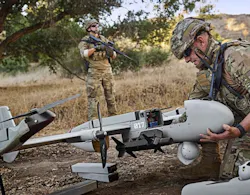
REDSTONE ARSENAL, Ala. – U.S. Army aviation experts needed small tactical uncrewed aircraft for small-unit persistent long-endurance intelligence, surveillance, and reconnaissance (ISR). They found a solution from AeroVironment Inc. in Simi Valley, Calif.
Officials of the Army Contracting Command at Redstone Arsenal, Ala., announced a $117.3 million contract to AeroVironment Friday for P550 longrange reconnaissance uncrewed aircraft. The contract does not disclose the number of P550s involved.
The vertical- and short-takeoff AeroVironment P550 is designed to stay airborne for many hours to monitor wide areas. It can operate far beyond the immediate battlefield to support deep reconnaissance.
55-pound uncrewed aircraft
The so-called Group 2 uncrewed aircraft weighs as much as 55 pounds, can carry a 15-pound sensor and communications payload, has a 17-foot wingspan, is nine feet long, and can fly for as long as five hours with a longwave infrared reconnaissance sensor payload. Its data link works at distances from 25 to 37 miles.
The uncrewed aircraft can carry electro-optical sensors, signals intelligence (SIGINT) systems, communications relays. It can operate without traditional airfields on missions like target acquisition and tracking.
The P550 uses satellite navigation from the Global Positioning System, as well as inertial navigation for areas where GPS navigation is not available. The uncrewed aircraft also has automated takeoff capability, and can follow pre-programmed waypoints, and can return to its launch point with minimal operator action.
Company and platoon users
Relatively small Army units of company and platoon size use the P550 to gather their own local reconnaissance without relying on higher-level headquarters. An Army company has 100 to 200 soldiers, while a platoon has 16 to 44 soldiers. The P550 also feeds data back to higher-echelon command and control to support broader operations.
AeroVironment introduced the P550 at a trade show in Washington in 2024. The Army's first P550 contract to AeroVironment was announced last December, with a base value of $13.2 million, which could increase to as much as $42 million.
On Friday's contract, AeroVironment will do the work at locations to be determined with each order, and should be finished by July 2026. For more information contact AeroVironment online at www.avinc.com/uas/p550, or the Army Contracting Command at www.army.mil/acc.
