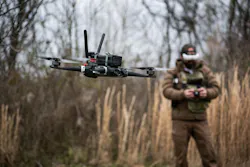
HUNTSVILLE, Ala., - The U.S. Army has awarded Performance Drone Works LLC in Huntsville, Alabama, a firm-fixed-price contract valued at $15,259,840 to procure 40 C100X MRD mission bundles, 80 Next Vision Raptor electro-optical/infrared (EO/IR) systems, and 17 UXV SROC ground control stations for the Small Uncrewed Aircraft Systems Product Office.
The Army has pushed toward modular, networked small uncrewed aircraft systems (sUAS) that combine air vehicles, sensor payloads, and ground control into integrated intelligence, surveillance, and reconnaissance (ISR) kits for small-unit operations. At the core of the award are C100-class quadcopter systems delivered as part of a mission bundle configuration. These bundles typically include the air vehicle, communications links, batteries, and payload interfaces in a portable configuration designed for rapid deployment, with an emphasis on open architecture payload integration that allows operators to swap ISR sensors or other mission equipment based on mission needs.
The aircraft are designed for expeditionary use in contested electromagnetic environments, incorporating secure digital datalinks and mission flexibility for a range of operational conditions. Their size and weight place them in the Army’s small UAS category, supporting platoon- to company-level reconnaissance, overwatch, and target-acquisition missions, with endurance that varies by payload and mission configuration, but is designed for extended small-UAS operations.
Related: Army seeks low-SWaP integration of next-generation uncooled thermal sensors
EO/IR systems
The contract also includes 80 Next Vision Raptor EO/IR systems, which function as the primary ISR payloads for the aircraft. These stabilized gimbals combine a high-zoom daylight camera with a thermal imager to enable full-motion video collection in both day and night conditions. The systems offer electro-optical zoom for detailed visual identification and thermal imaging capabilities that allow detection in darkness, smoke, or other obscurants.
Multi-axis stabilization supports effective imaging from small, mobile platforms, and onboard tracking and geolocation functions enhance situational awareness and targeting. The relatively low size, weight, and power (SWaP) profile of these payloads allows integration on small quadcopters while maintaining useful endurance and delivering high-resolution ISR capabilities.
Ground control
Seventeen UXV SROC Ground Control Stations round out the procurement by providing the operator interface for flight control, payload management, and ISR dissemination. These systems typically consist of ruggedized controllers or tablets running mission software that enables manual and autonomous flight operations, while also allowing operators to control sensors through functions such as zoom, tracking, and slew-to-cue.
The ground control stations provide real-time video downlink and recording, support mission planning with waypoint navigation and geofencing, and are designed to integrate with tactical data environments such as the Android Team Awareness Kit ecosystem. As the command-and-control node, the ground control station enables operators not only to fly the aircraft but also to exploit and distribute ISR data across tactical networks in support of broader tactical decision-making workflows.
Work locations and funding will be determined with each order, with an estimated completion date of 20 March 2027.