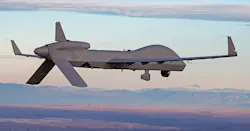
SAN DIEGO - The U.S. Army is upgrading its MQ-1C Gray Eagle Extended Range (ER) uncrewed aircraft with enhanced electronic intelligence (ELINT) capabilities under a contract awarded to General Atomics Aeronautical Systems Inc. (GA-ASI) in San Diego, Calif. Contract value and terms were not announced.
The ELINT capability supports long-range sensing for integrated air defense systems, providing ground commanders with threat awareness while allowing the aircraft to operate outside contested airspace. The upgrade also supports crewed-uncrewed teaming to improve survivability for crewed Army aircraft.
The Gray Eagle ER is a medium-altitude, long-endurance uncrewed aircraft capable of more than 40 hours of flight, with increased fuel capacity and payload flexibility compared to earlier variants. Powered by a heavy-fuel engine compatible with JP-8, the aircraft is designed for long-endurance operations while carrying a mix of sensors and networked payloads.
Related: General Atomics to build long-range unmanned aircraft with an open-systems architecture for reconnaissance
"Combining long-range detection with the range and persistence of the Gray Eagle platforms ensures that commanders always know when an adversary IADS is operating," said David R. Alexander, president of General Atomics Aeronautical Systems. "Gray Eagle’s open systems architecture makes this a simple but impactful upgrade."
Open architecture
Its open architecture design, aligned with the Modular Open Systems Approach (MOSA), including CMOSS principles, enables rapid integration of third-party technologies. The aircraft can host electro-optical and infrared sensors, such as the AN/AAS-53 Common Sensor Payload used on Gray Eagle aircraft; synthetic aperture radar; moving target indicator systems, including General Atomics’ Lynx synthetic aperture radar; and communications and electronic intelligence payloads.
This architecture enables sensor fusion and cross-cueing across payloads, allowing ELINT detections to inform follow-on collection from radar or electro-optical systems and support targeting against integrated air defense systems. Combined with its long endurance, the platform is designed for stand-off sensing, operating outside threat envelopes while maintaining visibility into contested areas.
The MOSA backbone also supports rapid payload insertion and upgrade cycles, enabling the Army to adapt the aircraft’s mission systems to evolving threats without major airframe modifications.
Related: GA-ASI, U.S. Air Force demonstrate autonomy at exercise using IR sensing for CCA
In addition to intelligence collection, the platform has demonstrated mobile ad hoc network radios and aerial tier networking capabilities, enabling it to function as an airborne communications node that connects dispersed forces. In this role, Gray Eagle can serve as a gateway for multi-domain operations, linking sensors, shooters, and command elements over extended distances.
The Gray Eagle ER participated in Project Convergence Capstone 5 in early March, where it operated in an electronically contested environment, integrating electronic intelligence, communications intelligence, and radar data while maintaining resilient communications links. Army officials say the demonstrations highlighted the platform’s ability to operate in jammed environments, fuse sensor inputs, and improve survivability for maneuver forces supporting combined joint operations.