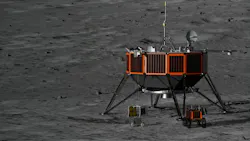
HOUSTON - The National Aeronautics and Space Administration (NASA) has awarded Intuitive Machines Inc. in Houston a $180.4 million contract to deliver seven science and technology payloads to the lunar south pole region, including a rover from the Australian Space Agency and systems developed by Blue Origin’s Honeybee Robotics.
The award, issued under NASA’s Commercial Lunar Payload Services (CLPS) initiative, marks the company’s fifth CLPS task order and the first requiring its larger cargo-class Nova-D lunar lander. The mission will use the company’s lunar landing system, space infrastructure, Space Data Network (SDN), and autonomous surface operations capabilities to deliver payloads and return data from the lunar surface.
The contract supports NASA’s broader Artemis campaign by advancing commercial lunar transportation and surface operations. Intuitive Machines expects to make additional payload capacity available beyond the CLPS manifest.
Related: Intuitive Machines and Nokia to deploy first cellular network on the moon
IM-5 mission goals
The IM-5 mission will target Mons Malapert, a ridge near the lunar south pole with continuous Earth visibility, stable lighting conditions, and proximity to permanently shadowed regions. These characteristics are considered important for future communications, navigation, and sustained lunar infrastructure.
Payloads on IM-5 will focus on sensing, environmental characterization, and surface interaction analysis. The Multifunctional Nanosensor Platform will conduct chemical analysis of plume-surface interactions to inform safer landing system designs and will fly aboard the Australian Space Agency’s rover. The Lunar Vehicle Radiation Dosimeter system includes four detectors to measure radiation conditions and assess impacts on future human activity.
NASA’s Laser Retroreflector Array will support precision navigation by reflecting laser signals from orbiters and spacecraft. The Stereo Cameras for Lunar Plume Surface Studies will capture high-resolution imagery of plume interactions during descent and landing. The Sanctuary payload will serve as a passive archive of human achievements.
Related: NASA highlights the technologies that will be sent to the Moon as part of Intuitive Machines' commercial mission
Lunar tech
Additional instruments include the Mass Spectrometer Observing Lunar Operations, a quadrupole mass spectrometer to characterize the lunar exosphere and monitor volatile species, and the Near Infrared Volatiles Spectrometer System, a modular suite for detecting and mapping volatiles and analyzing regolith composition.
The lander also will carry a next-generation lunar rover developed by Honeybee Robotics in Altadena, Calif., a Blue Origin company. The rover will host the Near Infrared Volatiles Spectrometer System and may incorporate additional capabilities for sampling, sensing, robotics, and autonomous operations to support surface exploration.
Intuitive Machines said the IM-5 mission will build on experience from its IM-1 and IM-2 missions and incorporate lessons learned into upcoming IM-3, IM-4, and IM-5 flights, including expanded use of its Space Data Network to provide persistent communications across the lunar surface and cislunar space.
Company officials say the mission is intended to demonstrate scalable lunar infrastructure capable of supporting increased mission cadence and sustained operations as NASA and its partners expand exploration of the Moon.