Reliable Robotics completes FAA contract for detect-and-avoid data collection flights
Key Highlights
- Conducted flight tests with remote pilots and simulated aircraft to evaluate collision avoidance in airport environments.
- Validated the FAA's ACAS X algorithm for use in autonomous UAS, enhancing safety in complex airspace scenarios.
- Reliable Robotics with industry leaders like Sagetech, Collins Aerospace, and uAvionix to develop and test prototype collision avoidance hardware and systems.
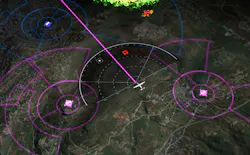
MOUNTAIN VIEW, Calif. - Reliable Robotics in Mountain View, Calif., announced the completion of a contract with the Federal Aviation Administration (FAA) under the Broad Agency Announcement (BAA) program to conduct detect-and-avoid (DAA) data collection flights in and around airport environments.
The effort supports the integration of large uncrewed aircraft systems (UAS) into the National Airspace System (NAS), where they must operate safely and efficiently across all classes of airspace, including terminal areas and traffic patterns. The flight test campaign generated validation data for the FAA as it finalizes certification standards for DAA systems, and for industry groups developing technical standards. Testing was conducted in collaboration with Virginia Tech’s Mid-Atlantic Aviation Partnership (MAAP), with support from Sagetech in White Salmon, Wash., Collins Aerospace, an RTX business, in Charlotte, N.C., and uAvionix in Bigfork, Mont.
Related: Reliable Robotics awarded military approval for its commercial autonomous flight system
Enabling remote piloting
Reliable’s DAA system is designed to enable remote pilots to meet remain well clear and collision avoidance requirements against all airborne traffic. The system is based on the FAA-developed Airborne Collision Avoidance System X (ACAS X) algorithm, which is intended to improve upon the Traffic Alert and Collision Avoidance System II (TCAS II) used on most transport-category aircraft. Variants of the algorithm include ACAS Xu, designed for autonomous fixed-wing aircraft.
To generate representative encounter data, Reliable conducted flight tests using a Cessna 208B equipped with its DAA system, flying RNAV (area navigation) approaches into Hollister Municipal Airport under its advanced automation system, commanded by a remote pilot operating from an off-site location about 50 miles away. An instrumented Cessna 182 acted as an intruder aircraft, flying converging paths to create controlled encounter geometries.
Engineers designed these encounters to simulate loss of safe separation while maintaining safety margins, placing strict constraints on operations near the closest point of approach. Each test required coordinated execution between the remote pilot and the intruder pilot, along with precise flight-path control to evaluate DAA alerting and collision-avoidance performance.
Related: GE integrates Aireon's space-based ADS-B into its Airspace Insight optimization tech
The FAA-contracted testing evaluated operational thresholds between en route and terminal environments and assessed the system’s ability to provide alerts and maneuver guidance to remote pilots. Reliable collected and shared flight data to support ongoing development of UAS DAA standards with the FAA.
"Demonstrating the ability of UAS to integrate into airport environments with a VFR traffic pattern is necessary for building a scalable aviation autonomy solution," said Brandon Suarez, vice president of UAS integration at Reliable Robotics. "The data Reliable captured through this testing under the FAA is nearly impossible to generate in a lab environment, and is tremendously useful in the development of relevant and useful standards. Through this testing, we’ve been able to confirm several key aspects of the technical standards that the FAA is leveraging for UAS."
Flight test findings
A key finding from the flight tests was the distinction between en route and terminal environments for DAA operations. The behavior and output of the ACAS X algorithm varied between these airspace types, reflecting adjustments similar to those made by pilots operating under instrument flight rules when interacting with visual flight rules (VFR) traffic. Maintaining collision protection against both cooperative and noncooperative aircraft at low altitudes during takeoff and landing remains a critical requirement for safe airport operations.
The campaign also stressed DAA performance against minimally equipped aircraft. The intruder Cessna 182 carried only the minimum equipment required for Automatic Dependent Surveillance-Broadcast (ADS-B) compliance, representative of legacy general aviation platforms. Because ADS-B Out data depends on GPS and must be validated for integrity, the tests required integration of cooperative surveillance data with noncooperative tracking sources to confirm target position and enable reliable collision avoidance alerts.
Related: Technologies that separate crewed and uncrewed aircraft
To complete the contract, Reliable conducted hardware-in-the-loop testing and a flight campaign that included scripted encounter scenarios in the terminal area at Hollister Municipal Airport in Hollister, Calif.
Reliable partnered with several vendors for the campaign, including Sagetech for prototype ACAS X hardware, Collins Aerospace for prototype ground-based radar, and uAvionix for prototype Skylink C-band communications equipment. Data from the test effort has been shared with RTCA Special Committee 228 and Special Committee 147 to support validation of emerging standards for advanced DAA systems.
About the Author
Jamie Whitney
Editor-in-Chief
Jamie Whitney joined the staff of Military & Aerospace Electronics in 2018 and oversees editorial content and produces news and features for Military & Aerospace Electronics, attends industry events, produces Webcasts, and oversees print production of Military & Aerospace Electronics.
Related
Voice Your Opinion!
To join the conversation, and become an exclusive member of Military Aerospace, create an account today!
 Leaders Logo
Leaders relevant to this article: